15 Galois Cohomology
Let be a group
and be a
-module (an abelian group
with an action of via group
homomorphisms). -module means
exactly the same thing as -module.
Definition ().
Define
|
|
Definition (Cochains).
Define
(called “cochains”).
Definition (Cocycles).
Define
|
|
(called “cocycles”).
Definition (Coboundaries).
Define
(called “coboundaries”).
Note.
.
Then we can define:
Remark.
If acts
trivially on ,
then
Theorem 15.1.
Assuming that:
-
we have a short exact sequence of
-modules
Then it gives rise to a long exact sequence of abelian groups:
|
|
Definition ().
Let . Then
such
that .
Then
so
for some .
Can check .
Then
class of
in .
Theorem 15.2.
Assuming that:
-
is a -module
-
a normal subgroup
Then there is an inflation restriction exact sequence
|
|
Let be a perfect field. Then
is a topological group with basis
of open subgroups being the
for .
If then we modify
the definition of
by insisting:
-
(1)
The stabiliser of each
is an open subgroup of .
-
(2)
All cochains
are continuous, where
is given the discrete topology.
Then
|
|
(direct limit is with respect to inflation maps).
Theorem (Hilbert’s Theorem 90).
Assuming that:
Proof.
Let .
Let .
Distinct automorphisms are linearly independent, so there exists
such
that
Then
Then
for all .
(
).
So .
Therefore .
□
Corollary.
.
Application: Assume . There is
a short exact sequence of -modules
Long exact sequence:
Therefore .
If then
|
|
Finite subgroups of
are of the form for
a finite abelian
extension of of
exponent dividing .
This gives another proof of Theorem 11.2.
Notation.
means .
Let be an isogeny of
elliptic curves over . Short
exact sequence of -modules
has long exact seqeucne
|
|
We get a short exact sequence
Now
take
a
number field.
For each place , fix
an embedding .
Then .
Definition (Selmer-group).
We define the -Selmer
group
(the map is
as in the commutative diagram above).
Definition (Tate-Shafarevich group).
The Tate-Shafarevich group is
|
|
We get a short exact sequence
|
|
Taking
gives
|
|
Reorganising the proof of Mordell-Weil gives
Theorem 15.3.
is finite.
Proof.
For
a finite Galois extension,
Therefore by extending our
field, we may assume
and
hence by the Weil pairing
.
Therefore as a
-module.
Then
Let
|
|
(a finite set of places).
Define the subgroup of
unramified outside of
as
|
|
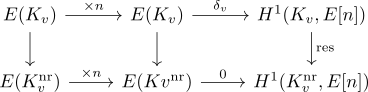
There is a commutative diagram with exact rows:
The bottom
map
is
surjective
(see
Theorem 9.8).
Therefore
But
which is finite by Lemma 11.4. □
Remark.
is finite and effectively computable.
It is conjectured that .
This would imply that
is effectively computable.