4 The Group Law

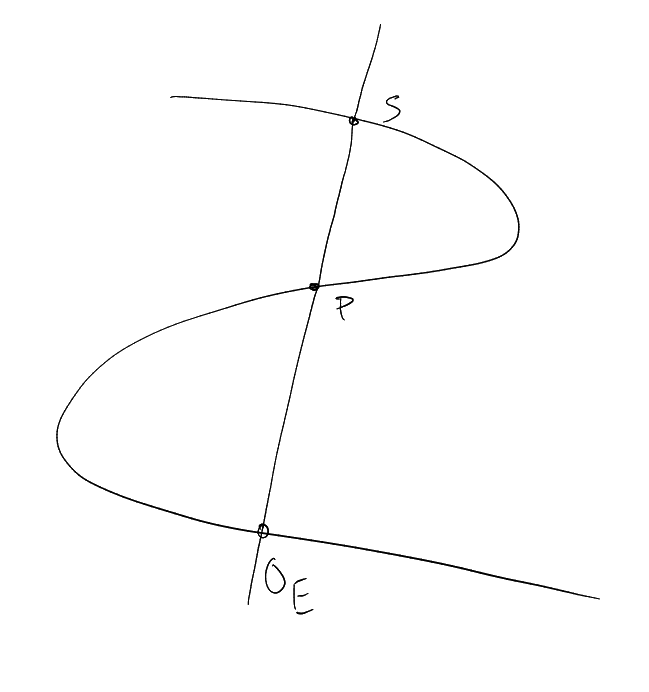
Let E⊂ℙ2 be a smooth plane cubic, and 0E∈E(K).

PIC

E meets any line in 3 points counted with multiplicity.

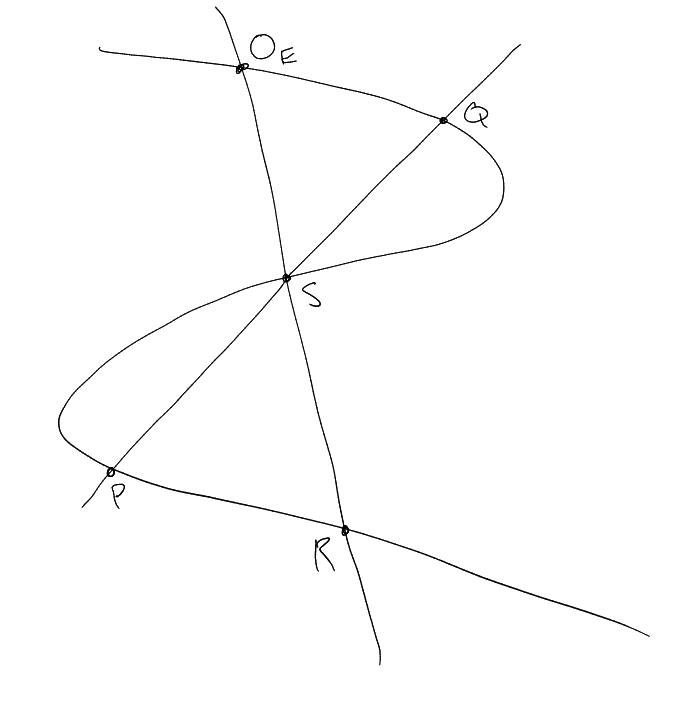
Let S be the third point of intersection of PQ with E, and R be the third intersection point of 0ES and E.

Define P⊕Q=R.

If PQ then take TPE instead of PQ etc.

This is called the “chord and tangent process”.

Theorem 4.1. (E,⊕) is an abelian group.

Note. E here means E(K¯). As mentioned before, we only ever mean “over K” if it is explicitly mentioned (otherwise we are always working “over K¯”).

Proof.

  • (i) ⊕ is clearly commutative.
  • (ii) 0E is the identity:

    PIC

    0E⊕P=P.

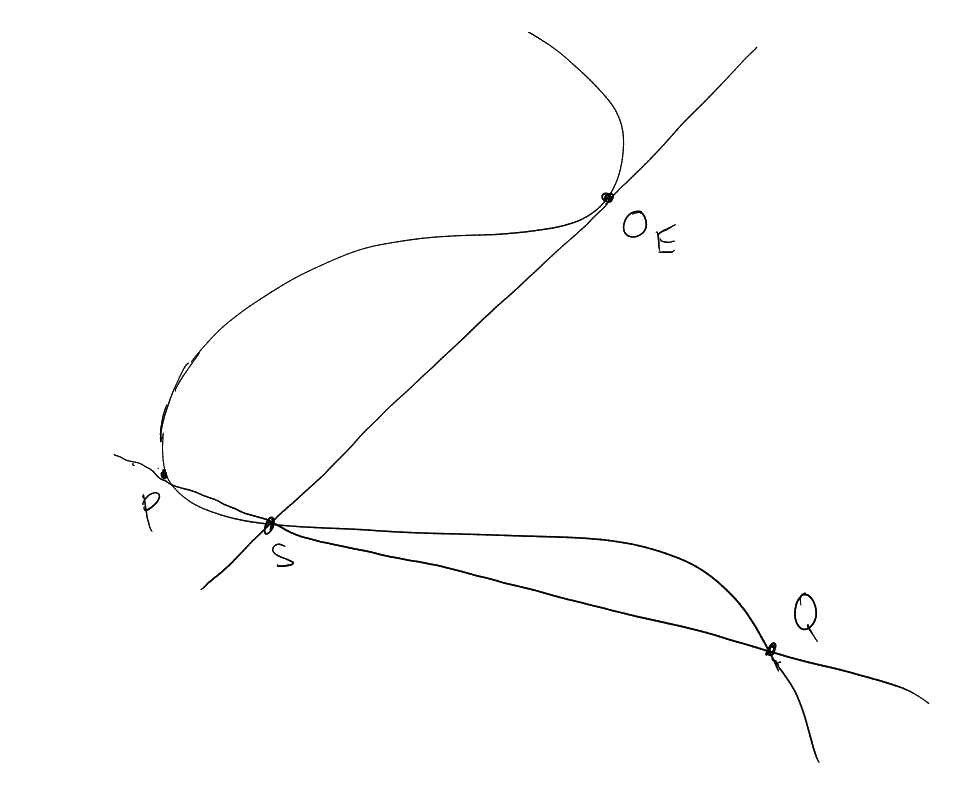
  • (iii) Inverses:

    PIC

    Let S be the third point of intersection of T0EE and E, and let Q be the third point of intersection of PS and E.

    Then P⊕Q=0E.

  • (iv) Associativity: much harder! We will develop a bit of theory first. □

Definition (Linearly equivalent). D1,D2∈Div⁡(E) are linearly equivalent if there exists f∈K¯(E)∗ such that div⁡(f)=D1−D2.

Write D1∼D2 and [D]={D′:D′∼D}.

Definition. Pic⁡(E)=Div⁡(E)∼, Pic⁡0(E)=Div⁡0(E)∼. where Div⁡0(E)={D∈Div⁡E| deg ⁡⁡D=0}.

Proposition 4.2. Assuming that:

  • we define

    ψ:E→Pic⁡0(E)P↦[(P)−(0E)]

Then
  • (i) ψ(P⊕Q)=ψ(P)+ψ(Q).
  • (ii) ψ is a bijection.

Proof.

  • (i) div⁡(l∕m)=(P)+(S)+(Q)−(0E)−S−(R)=(P)+(Q)−(0E)−(P⊕Q)

    Hence (P)+(Q)∼(P⊕Q)+(0E). Therefore (P⊕Q)−(0E)∼(P)−(0E)+(Q)−(0E). So ψ(P⊕Q)=ψ(P)+ψ(Q).

  • (ii) Injectivity: Suppose ψ(P)=ψ(Q) with P≠Q.

    Then there exists f∈K¯(E)∗ such that div⁡(f)=(P)−(Q), so E→fℙ1 has degree 1, hence E≅ℙ1, contradiction.

    Note: We now compute

    ψ((P⊕Q)⊕R)=ψ(P)+ψ(Q)+ψ(R)=ψ(P⊕(Q⊕R))

    hence (P⊕Q)⊕R=P⊕(Q⊕R) for all P,Q,R∈E (using injectivity). So (E,⊕) is associative.

  • (iii) Surjectivity: Let [D]∈Pic⁡0(E). Then D+(0E) has degree 1.

    Riemann Roch gives dim⁡L(D+(0E))=1. So there exists 0≠f∈K¯(E) such that

    div⁡(f)+D+(0E)⏟degree 1≥0.

    So

    div⁡(f)+D+(0E)=(P)

    for some P∈E. Then (P)−(0E)∼D, so ψ(P)=[D]. □

Formulae for E in Weierstrass form
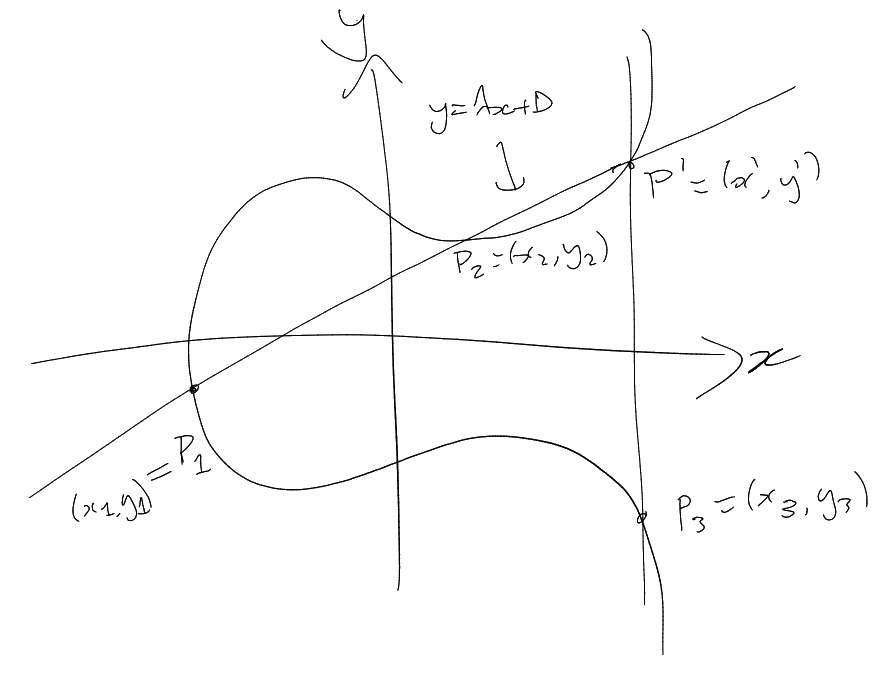
E:y2+a1xy+a3y=x3+a2x2+a4x+a6(∗)

0E=(0:1:0).

PIC

P1⊕P2=P3. ⊖P1=(x1,−(a1x+a3)−y1).

Substituting y=λx+ν into (∗) and looking at coefficient of x2 gives

λ2+a1λ−a2=x1+x2+x′⏟=x3.

Therefore

x3=λ2+a1λ−a2−x1−x2y3=−(a1x′+a3)−y′=−(a1x3+a3)−(λx3+ν)=−(λ+a1)x3−a3−ν

It remains to find formulae for λ and ν.

Corollary 4.3. E(K) is an abelian group.

Proof. It is a subgroup of (E,⊕). Identity 0E∈E(K) by definition.

Closure / inverses: see formulae above.

Associative / commutative: inherited. □

Theorem 4.4. Elliptic curves are group varieties, i.e. [−1]:E→E; P↦⊖P and ⊕:E×E→E; (P,Q)↦P⊕Q are morphisms of algebraic varieties.

Proof.

  • (i) Above formulae imply [−1]:E→E is a rational map, and hence a morphism (by Remark 2.9).
  • (ii) Above formulae imply ⊕:E×E→E is a rational map regular on
    U={(P,Q)∈E×E|P,Q,P⊕Q,P⊖Q≠0E}.

    For P∈E, let τP:E→E; X↦X⊕P “translation by P”.

    τP is a rational map, and hence a morphism (by Remark 2.9).

    Take any A,B∈E. We factor ⊕ as

    E×E→τ⊖A×τ⊖BE×E→⊕E→τA⊕BE.

    This shows ⊕ is regular on (τA×τB)(U) for all A,B∈E. Therefore ⊕ is regular on E×E. □

Statement of Results

The isomorphisms in (i), (ii), (iv) respect the relevant topologies.

Brief remarks on the case K=ℂ

Let

Λ={aω1+bω2:a,b∈ℤ},

where ω1,ω2 a basis for ℂ as an ℝ-vector space.

Then

{meromorphic functions on the Riemann surface ℂ∕Λ}↔{Λ-invariant meromorphic functions on ℂ}.

The function field of ℂ∕Λ is generated by

℘(z)=1z2+∑0≠λ∈Λ(1(z−λ)2−1λ2)℘′(z)=−2∑λ∈Λ1(z−λ)3

These satisfy

℘′(z)2=4℘(z)3−g2℘(z)−g3

for some g2,g3∈ℂ depending only on Λ.

One shows ℂ∕Λ=E(ℂ) (isomorphism as groups and as Riemann surfaces) where E: y2=4x3−g2x−g3.

Theorem (Uniformisation Theorem). Every elliptic curve over ℂ arises this way (one proof uses modular forms).

Definition. For n∈ℤ, let [n]:E→E be defined by

P↦P⊕P⊕⋯⊕P⏟n copies

for n≥0, and [−n]=[−1]∘[n].

Definition (n-torsion subgroup). The n-torsion subgroup of E is

E[n]=ker⁡(E→[n]E).

If K=ℂ then E(ℂ)≅ℂ∕Λ. Therefore

{E[n]≅(ℤ∕nℤ)2(1)deg⁡[n]=n2(2)

We’ll show (2) holds over any field K, and (1) holds if char⁡K∤n.

Lemma 4.5. Assuming that:

  • char⁡K≠2

  • E: y2=f(x)=(x−e1)(x−e2)(x−e3), e1,e2,e3∈K¯

Then E[2]={0E,(e1,0),(e2,0),(e3,0)}≅(ℤ∕2ℤ)2.

Proof. Let P=(x,y)∈E. Then

[2]P=0⟹P=−P⟹(x,y)=(x,−y)⟹y=0□