3 Weierstrass Equations
In this section, we drop the assumption that ,
but we instead assume that
is a perfect field.
Definition (Elliptic curve).
An elliptic curve
is a smooth projective curve of genus ,
defined over
with a specified -rational
point .
Example.
is not an
elliptic curve over ,
since it has no -rational
points.
Theorem 3.1.
Assuming that:
Then is isomorphic over
to a curve in Weierstrass form
via an isomorphism taking
to .
Remark.
Proposition 2.7 treated the special case
is a smooth
plane cubic and
is a point of inflection.
Fact: If
is defined over
(i.e. fixed by )
then has a
basis in
(not just ).
Proof of Theorem 3.1.
.
Pick basis
for
and
for .
Note: ,
.
The 7 elements
in the 6-dimensional space
must satisfy a dependence relation.
Leaving out
or
gives a basis for
since each term has a different order pole at .
Therefore the coefficients of
and are non-zero.
Rescaling
and (if
necessary) we get
|
|
for some .
Let be
the curve defined by this equation (or rather its projective closure). There is a morphism
Then
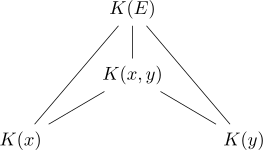
This gives us a diagram of field extensions:
By the Tower Law
(since
are coprime),
we get that
.
Hence
,
so
, so
is
birational.
If is singular
then
and are
rational, contradiction.
So is smooth. Then
Remark 2.9 implies that
is a morphism. So
is an isomorphism. □
Proposition 3.2.
Assuming that:
Then
over if
and only if
the equations are related by a change of variables
where
with .
Proof.
-
Obvious.
-
hence
for some
with .
implies
for some
with .
Looking at coefficients of
and ,
we get .
So ,
for some .
Put .
□
A Weierstrass form equation defines an elliptic curve if and only if it defines a smooth curve, which happens if and
only if ,
where
is a certain polynomial.
If , we may reduce
to the case , with
discriminant .
Corollary 3.3.
Assuming that:
Then and
are isomorphic
over if and
only if ,
for
some .
Proof.
and
are related by a substitution as in Proposition 3.2 with .
□
Definition (-invariant).
The -invariant
is
Corollary 3.4.
Assuming that:
Then . Moreover, the
converse holds if
.
Proof.
and the converse holds if (to go
backwards on the step, we only
need to take some kind of -th
root). □