4 Lovasz-Erdős Local Lemma
What is the idea fo a local lemma? It’s a general statement in probability about when a certain probability is
non-zero.
A silly example: Say I have
independent coins. How do I prove that there exists a configuration of these coins such that everything is
heads?
Our earlier techniques don’t work on something like this: before we either started with an event that
holds with probability, or something that is close to an event that holds with high probability.
heads is
neither of these things, but obviously it exists because everything is independent.
The Local Lemma allows us to show that the probability of an event is non-zero provided we have “enough”
independence, which we make precise below.
Lemma 4.1 (Erdős-Lovasz, 70s).
Assuming that:
-
is a family of events in a probability space
-
-
,
where
is the max degree of
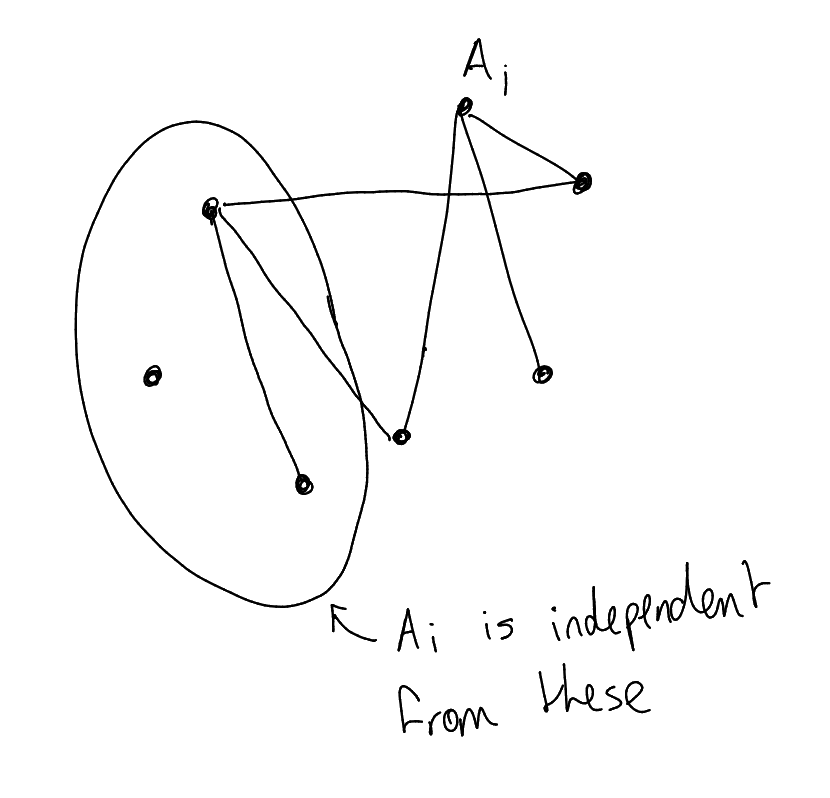
Definition 4.2 (Dependency graph).
If
is a family of events, a dependency graph
is a graph with vertex set ,
with the property that: for all ,
the event
is independent from .
Note that a family of events
can have many possible dependency graphs, but in applications there is often a particularly natural choice to
take.
Picture:
Reminder: is
independent from if
is formed by taking
intersections of ,
we have
Theorem 4.3 (Spencer).
.
Proof.
Let and let
. Choose a colouring uniformly
at random. For every ,
define the event
|
|
We clearly have .
Let be a dependency
graph on ,
where we say
if .
|
|
We now check:
|
|
This .
So the condition in Local Lemma holds for sufficiently large .
□
Remark.
This is the best known lower bound for diagonal Ramsey.
Definition 4.4 (-uniform hypergraph).
Say
is a -uniform
hypergraph on vertex set
if .
Definition 4.5 (Colourable hypergraph).
Say a hypergraph
is -colourable
if there exists
such that there is no monochromatic .
Theorem 4.6.
Assuming that:
Then is
-colourable.
Note.
This theorem has no condition on
in the assumptions. Thus, this theorem is not just picking out a high probability event out of all uniformly random
colourings: if
is large and has a reasonable number of edges, then with high probability there will be a monochromatic edge.
Proof.
We choose our colouring of the ground set
uniformly at random. For each ,
define the event
We have , so we want
. Note if we define our
dependency graph
by if
, then
Now just use the bound on
in the hypothesis. □
Remark.
Actually, our second application implies the first on
: just let
be the
-uniform
hypergraph on ,
defined by
We now move onto proving Local Lemma.
Theorem 4.7 (Lopsided Local Lemma).
Assuming that:
This is slightly more mysterious than the first form, but it can be much more useful. Specifically, if the probabilities
aren’t all the same, then this lopsided form allows us to tune the values of
more precisely than if we just use Local Lemma. We’ll see an example of this at the end of this
section.
Proof.
We use
Applying this many times, we have
We will prove that this term is
by instead proving the more general statement:
where . We prove
by induction on .
If , then
done by hypothesis.
If , then
define
|
|
Note that
Let be the events
in the intersection .
Then
If no events in the intersection, then we are already done. Otherwise, we may apply the induction hypothesis
to each term to get
|
|
Now we will see another proof of
(Theorem 3.1), in order to give some intuition as to what kind of situations are good for Local Lemma.
Roughly speaking, it works well if your events are “weakly dependent”, or there are “not too many
dependencies” among them.
Proof of using Lopsided Local Lemma.
Recall that it is enough to show that for sufficiently large ,
there exists a triangle-free graph on
vertices with
(this was the statement of Theorem 3.2).
Set ,
and sample
where ,
with
is chosen later.
Define the events:
-
For each ,
define
-
For each ,
define
Define the dependency graph :
-
for
if .
-
for
if .
-
for
if .
Now note:
-
The event
is
to
,
.
-
The event
is
to
,
.
-
The event
is
to
,
.
-
The event
is
to
,
.
We choose
for all
(“we want to make it a bit bigger than the probability of it occuring so that we can afford the product stuff”)
and for
all .
Then
for large enough .
We have ,
so
Note
|
|
First choose
small so , and
then choose ,
then done. □