3 An edge deletion method
In this section, we’ll improve the lower bound on
that we proved in Theorem 2.3.
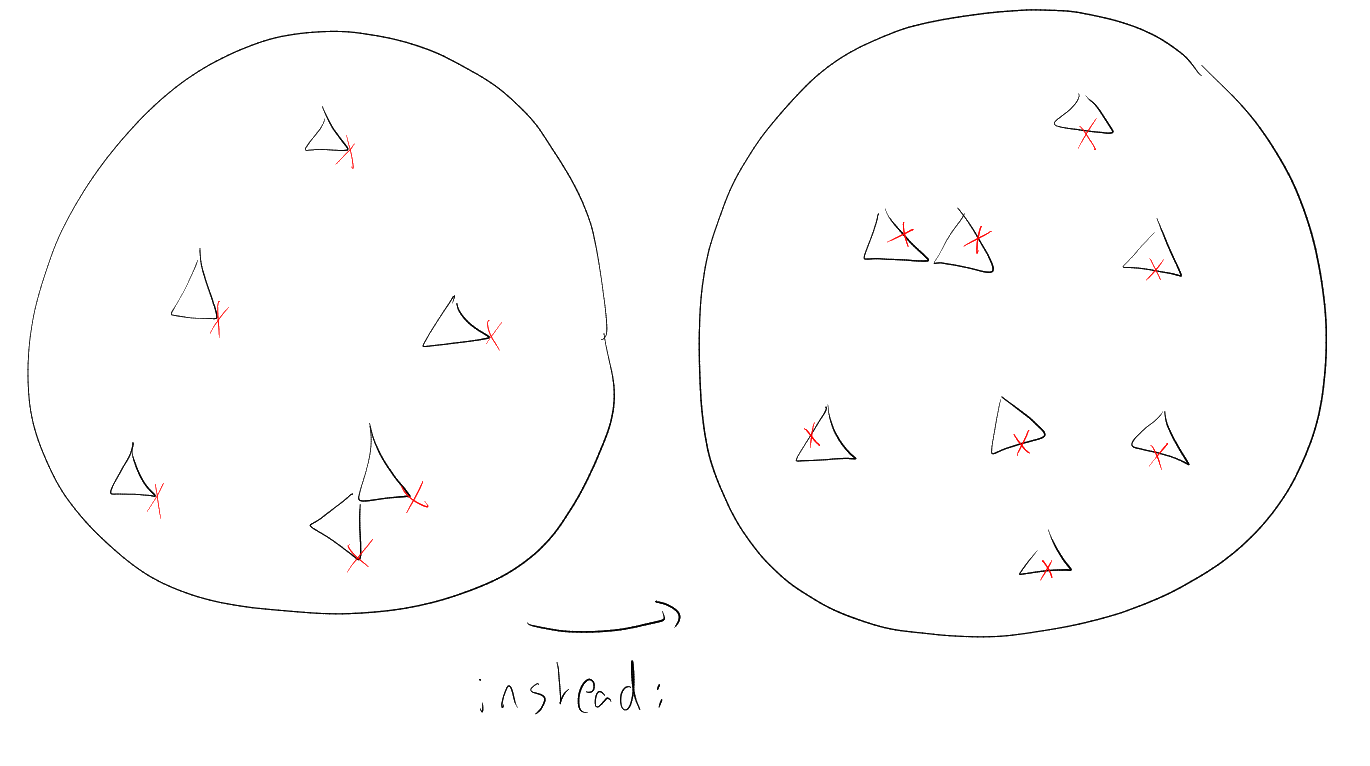
Idea: let’s delete an edge from each triangle, instead of a vertex (we have a lot more edges to spend than we
have vertices!). “The vertex set is our most expensive real estate.”
For this we want
so . For
some small .
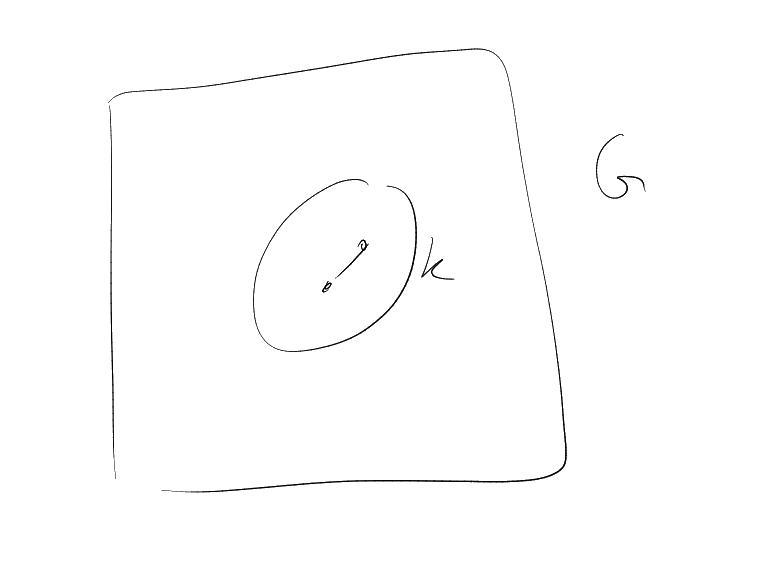
Danger: when we delete an edge from each triangle, we need to ensure that we don’t hurt
.
Theorem 3.1 (Erdos, 1960s).
for some .
Since we already saw
in Corollary 2.2 (which followed from Erdos-Szekeres, 1935), this theorem now tells us the polynomial order
of (up
to poly-logs).
To prove this, it is enough to prove the following:
Theorem 3.2.
There exists a constant
such that for all , there
exists a triangle-free graph
on
vertices with
Proof of Theorem 3.1 from Theorem 3.2.
Set ,
and then get .
□
When proving Theorem 3.2, note that we only have to prove it for large
, because then we can just
adjust our value of to make
the result also true for small .
Now we sketch the idea of Theorem 3.2: we know
.
What if ? Then there
must be an edge (because .
Not very impressive.
What if ? Then we actually
get a lot of edges: expect ,
and can guarantee .
Lemma 3.3.
Assuming that:
-
-
-
Then with high probability every set of size
in induces
at least
edges.
This lemma will be used to show that we can delete an edge from every triangle without increasing the
independence number of our graph too much, but we will see later that a small trick is needed before we can
apply this.
Proof.
Fix
and fix a set
with size .
for some .
We now union bound over all .
(using )
which
for .
□
Lemma 3.4.
Assuming that:
-
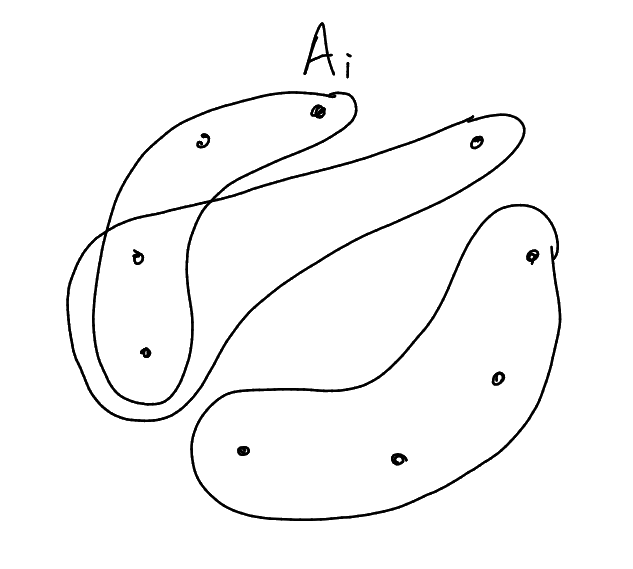
be a collection of events
-
let ,
for ,
be the event that
independent events of
occur
Remark.
.
Using for
large in
the above lemma, we get:
|
|
Proof.
Let .
𝟙𝟙
Proof of Theorem 3.2.
Let
be large. Let
for some .
Let .
Here comes a smart idea: instead of deleting an edge from every triangle in an arbitrary way, we will
do it in a slightly smarter way.
Let
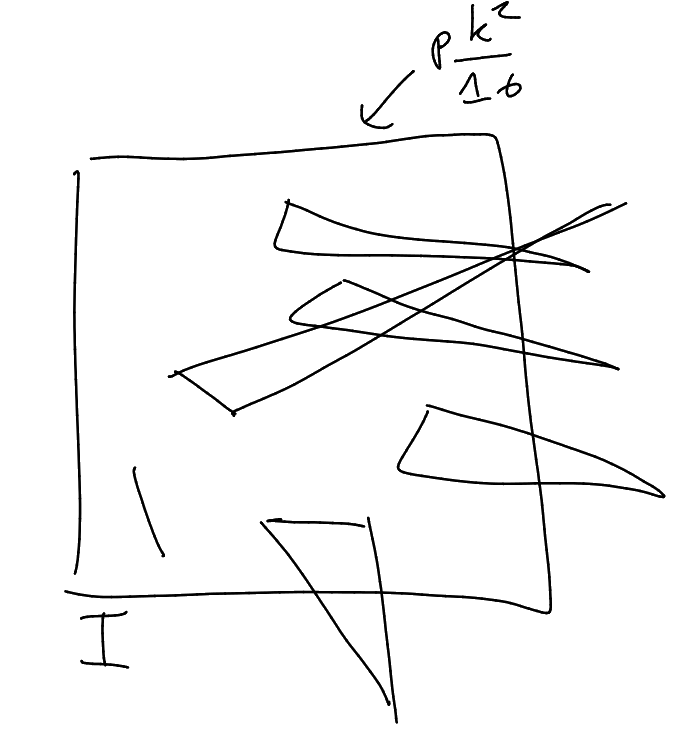
be a maximal collection of edge disjoint triangles in ,
and let .
By maximality of ,
is triangle-free.
We’ll see shortly that adding this little bit of structure is very helpful for making the proof go through
(i.e. the proof that the independence number is still large).
To show that the independence number of
is large, we will do a common and useful kind of manoeuvre. We want to take a big union bound over
all independent sets, but this union bound only works if we can show that all the individual events
occur with low enough probability to “beat out” the count of the number of events that we take a
union over.
If the events are somewhat or very correlated, then we are very much at risk of the sum of probabilities
being large, because we might be overcounting by too much.
In this case, we will get around the issue by introducing a quasirandomness property
that holds with high probability, and has the nice property that the events become less correlated if we
condition on .
Then we will be able to apply a union bound by conditioning on .
So we will “prepare globally, then zoom in locally”.
We let be the event
that every set of size ,
where , contains
at least edges.
By Lemma 3.3,
occurs with high probability. We now consider
|
|
So
|
|
We now union-bound
Define to be the collection of all
triangles that meet in at least
one edge, and define the event .
Note that the event ,
where , from the lemma
holds on the event that
meets
in
edges. This is where we use the fact that we only choose edge-disjoint triangles! By Lemma 3.4, we
have
So
|
|
if is chosen to
be small and
large. □