12 Different and discriminant
Notation.
Let .
Set
where are distinct
embeddings and .
Note:
-
If ,
,
then
|
|
where .
-
If ,
then .
Lemma 12.1.
Assuming that:
Then the Trace form
is non-degenerate if and only if
where is a finite
separable extension of .
Proof.
Example Sheet 3. □
Theorem 12.2.
Assuming that:
Then
-
(i)
If
ramifies in ,
then for every ,
we have .
-
(ii)
If
is unramified in ,
then there exists
such that .
Definition 12.3 (Discriminant).
The discriminant is the ideal
generated by
for all choices of .
Corollary 12.4.
ramifies if and only if
. In particular, only finitely
many primes ramify in .
Definition 12.5 (Inverse different).
The inverse different is
|
|
an
submodule of .
Lemma 12.6.
is a
fractional ideal in .
Proof.
Let
a -basis
for . Set
|
|
which is non-zero since separable.
For write
with
. We
show .
We have
|
|
Set .
Multiplying by ,
we get
|
|
Since ,
we have .
Thus ,
so
is a fractional ideal. □
The inverse
of is
the different ideal.
Remark.
since .
Let ,
be the
groups of fractional ideals.
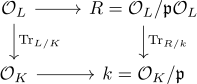
Theorem 9.7 gives that
|
|
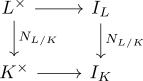
Define
induced by
for and
.
Fact:
(Use
Corollary 10.10 and
for msub where
and
are the normalised
valuations for ,
).
Theorem 12.7.
.
Proof.
First assume ,
are PIDs.
Let be
an -basis for
and
be the dual basis with
respect to trace form. Then
is a basis for .
Let be
the distinct embeddings. Have
|
|
But
|
|
Thus
Write
since .
Then
Thus
so
In general, localise at
and use .
Then .
Details omitted. □
Theorem 12.8.
Assuming that:
-
-
has monic minimal polynomial
Proof.
Let be
the roots of .
Write
|
|
with
and .
We claim
|
|
for .
Indeed the difference is a palynomial of degree ,
which vanishes for .
Equate coefficients of ,
which gives
Since is
an basis
for ,
has an
basis
|
|
Note all of these are
multiples of the last term, since the
are in .
So ,
hence .
□
a prime
ideal of ,
.
using
,
. We identify
with a
power .
Theorem 12.9.
(finite product, see later).
Proof.
Let ,
. Then
|
|
(of Corollary 10.10).
Let ,
.
Corollary 12.10.
.
Proof.
Apply
to .
□