8 Szemerédi Regularity Lemma
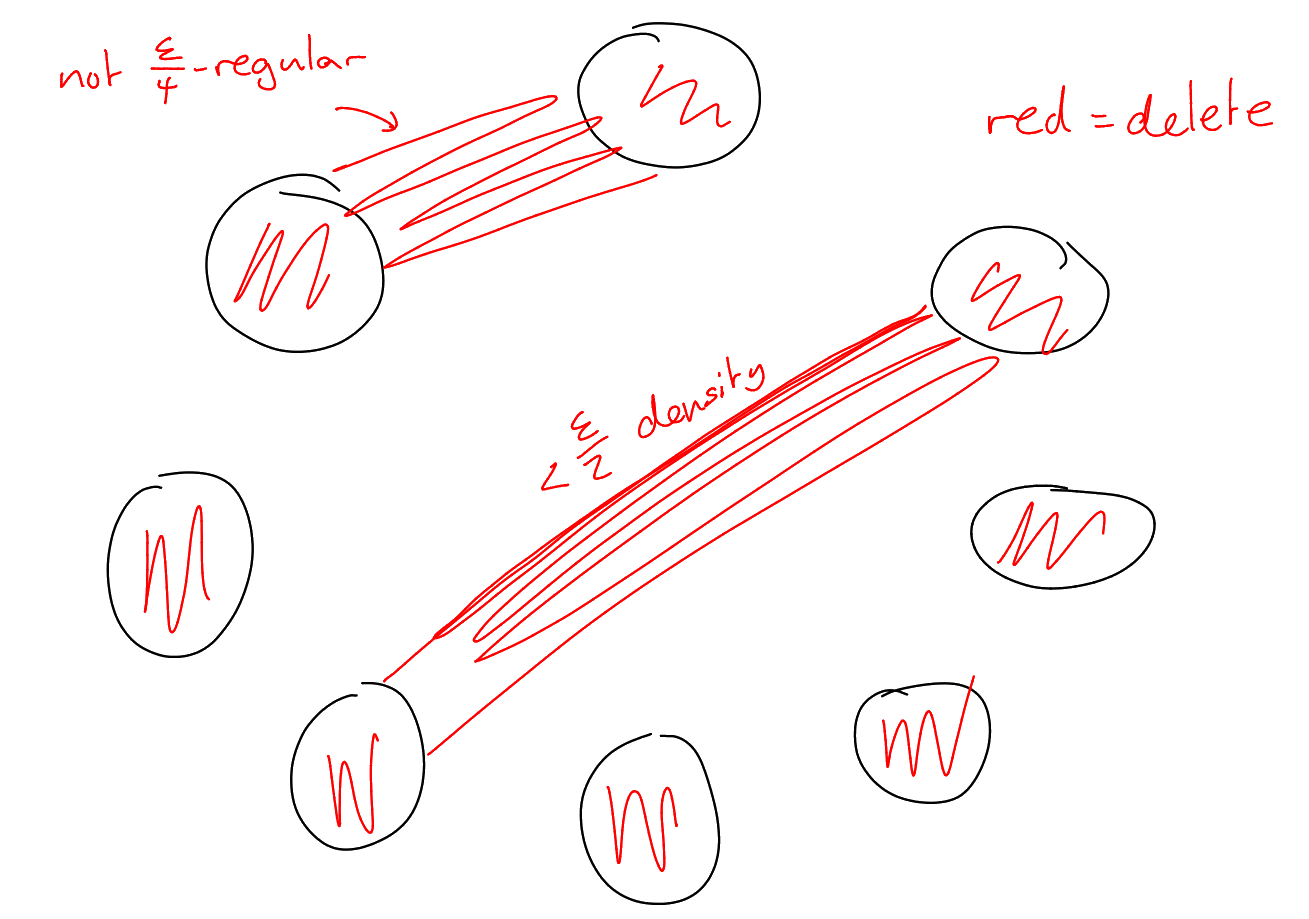
Informal statement
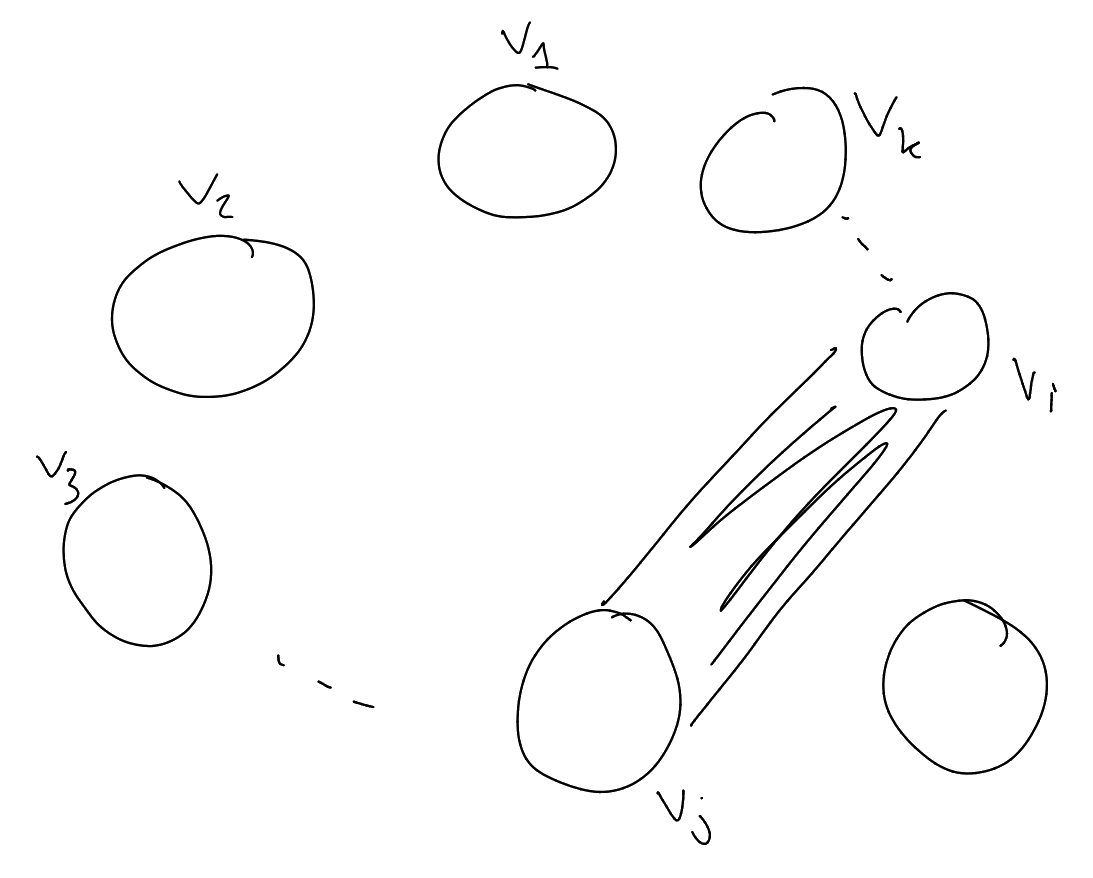
Let be a
graph, . We
can partition
into equal parts
where depends only on a
“coarseness” parameter ,
so that for all but pairs
, the graph
between ,
“looks”
quasi-random.
So, in a sense, “every graph is somewhat random”.
Definition 8.1 (Edge density).
Let
be a graph. Let .
First define
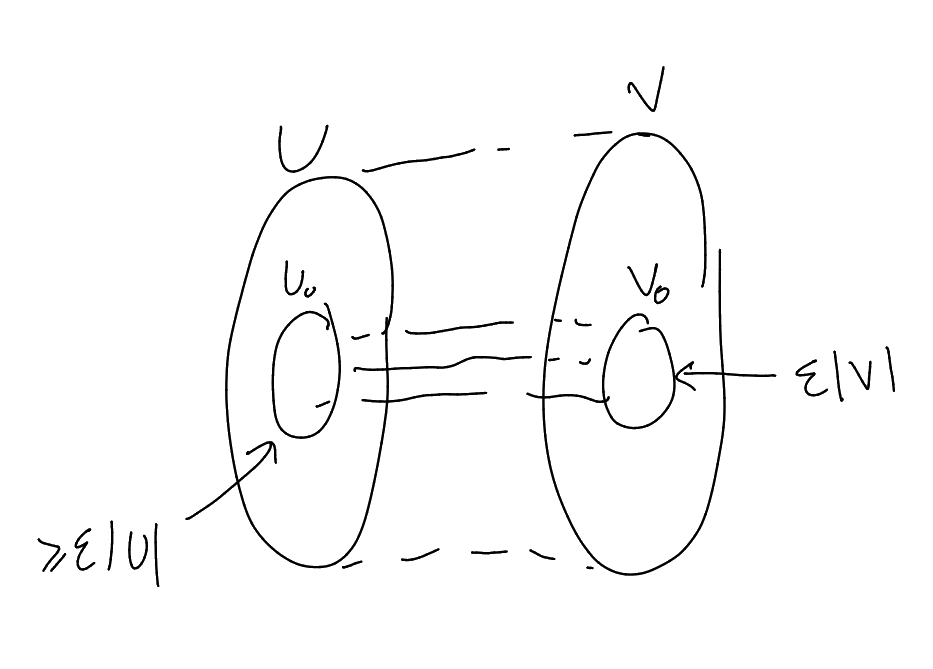
Definition 8.2 (-uniform).
We say that is
-uniform if
and
,
whenever
and .
Fact: Let be a graph
and let disjoint
which are -uniform.
Let .
Then
Proof.
Simply note that if
|
|
we have ,
hence
due to uniformity.
Second case is the same. □
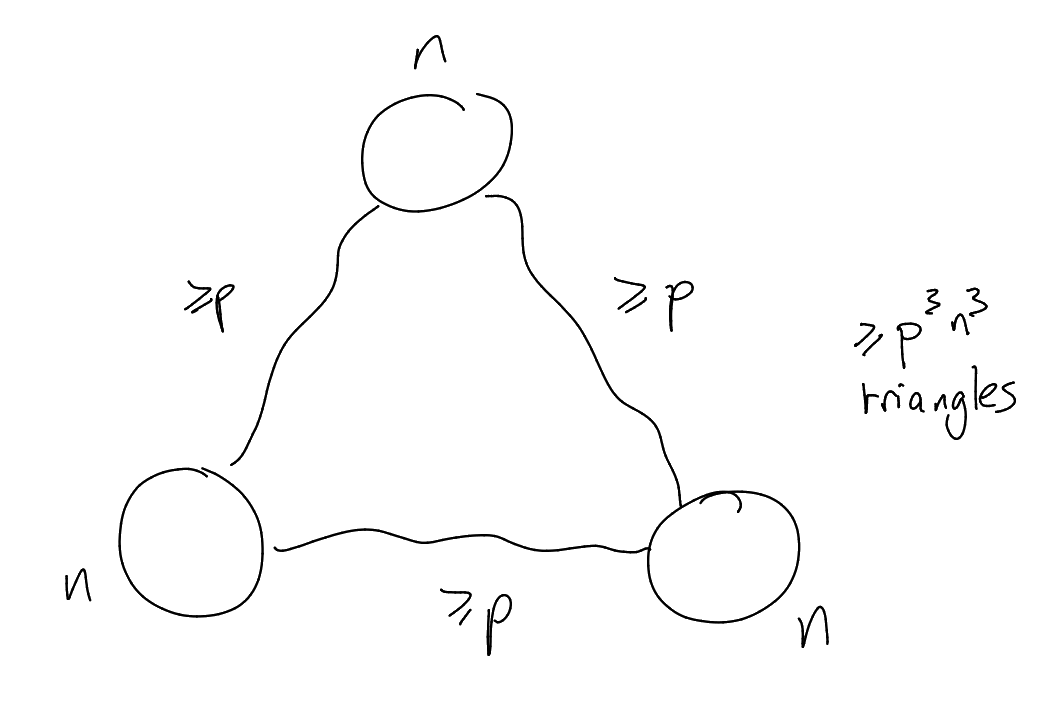
Lemma 8.3 (Counting lemma for triangles).
Assuming that:
Then the number of triangles in
is
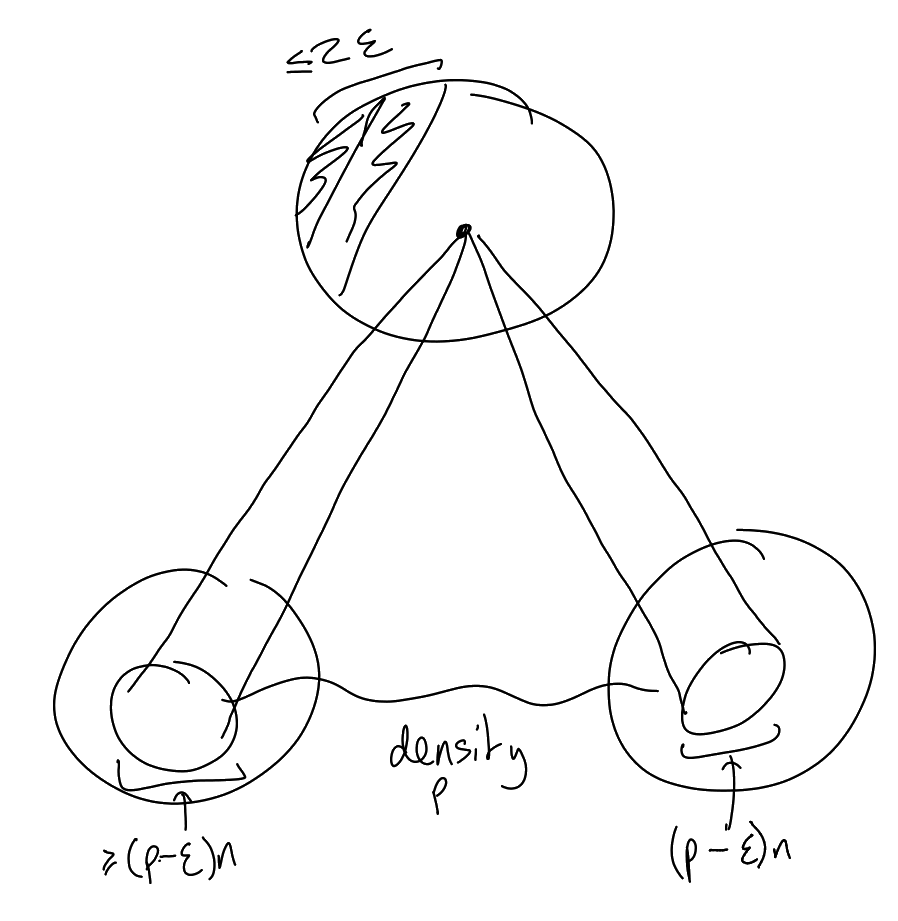
Proof.
Let
|
|
Note that .
Now fix
and note
using the -uniform
and . So summing
over all
gives us
triangles. □
Definition 8.4 (Equipartition).
Say that
is an equipartition if
for all .
Theorem 8.5 (Szemerédi Regularity Lemma).
Assuming that:
Then there exists
such that the
following holds: Let
be a graph.
Then there is an
equipartition of
,
where
and such
that all but
pairs
, we
have that
is
-uniform.
Remark.
-
Technically, the Szemerédi Regularity Lemma also applies when ,
but often it does not really tell us anything.
-
The dependence on
of
is of tower type, i.e.
Gowers proved that
So these tower bounds are necessary.
Theorem 8.6 (The triangle Removal Lemma).
For all
, there exists
so that the following
holds: Every graph
on vertices
with triangles
contains
with
and .
Proof.
Let be
given, let
and define .
Let be a
graph with
triangles.
Apply Szemerédi Regularity Lemma to
to find ,
with .
Now define
We note
Let’s see that is
triangle-free. If not, then
with ,
,
. So we
must have
and is
-uniform.
So we can apply the “counting lemma” for triangles to find that the number of triangles is at least
|
|
which contradicts the initial assumption. □
Remark.
-
This proof gives tower-type dependence
between
and .
-
It’s a big question to improve these bounds.
-
Best known is due to Fox, who proved that
is sufficient.
Theorem 8.7 (Roth).
For
there exists
such that if
and
with ,
then
contains
where .
Proof.
For
given, let be the
from The triangle
Removal Lemma. Let .
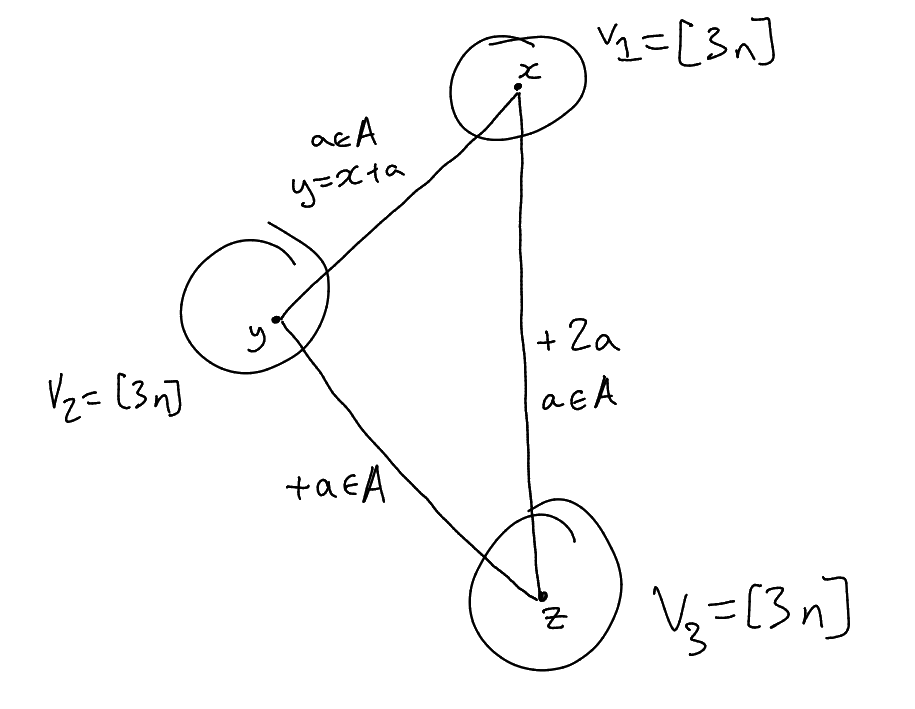
Now given a set ,
we define a graph
on where
are disjoint
copies of
and:
Say then ,
,
form a
triangle in .
So ,
,
for
some .
Then
|
|
hence .
If is no
-term arithmetic progressions,
then only contains
triangles of the form ,
where .
So contains
triangles.
So apply the The triangle Removal Lemma to find
with
such that
is triangle-free. This
is possible since .
But now notice that
is a set of edge-disjoint triangles of size
and hence
so .
□
Remark.
-
Again this gives bad bounds on our minimum density .
-
Roth showed that if ,
,
then
contains a -term
arithmetic progression.
-
Kelley–Meka showed that the same holds for .
There exist
with no -term
arithmetic progression but