6 Dependent Random Choice
Definition 6.1 (-rich).
Let be a graph.
Say that is
-rich if for
every
we have
Theorem 6.2 (Dependent Random Choice).
Assuming that:
Then there exists
,
which
is
-rich.
Note that
doesn’t appear in the conclusion. It is a parameter that we can tune appropriately in applications.
Proof.
We sample
uniformly at random (with replacement). Then
𝟙
Let be the random variable
that counts the number of
with
We want
to be not too big. This will be the case (on average) because
is an increasing
function of
(so our probability distribution is biased away from fully selecting tuples that will increase
). We
make this precise as follows:
Note
|
𝟙 |
so
To finish, define to
be with a vertex
deleted from each
with . By
definition, is
-rich, so we now just
need to ensure that
holds for some choice of .
Indeed,
The last line follows from the assumption. □
Definition 6.3 (Extremal number).
Let
be a graph. The extremal numbers of
are
|
|
Theorem 6.4 (Erdős-Stone).
Assuming that:
Then |
|
Definition 6.5 (Complete bipartite graph).
is the complete bipartite graph with parts of sizes ,
respectively.
If , then for
all , we have
. More generally, a
complete -partite graph
will not contain a copy of .
Erdős-Stone says that these constructions are optimal, up to
edges.
Erdős-Stone doesn’t help us when .
In this case, it is true that
|
|
See Part II Graph Theory for proofs of both bounds.
These bounds are essentially the best known for .
We now prove a generalisation of this upper bound that holds for graphs other than complete bipartite
graphs:
Theorem 6.6 (Füredi).
Assuming that:
Then
for some
( depends
only on and
not on ).
Lemma 6.7.
Assuming that:
Then .
Proof.
First inject .
We now inductively place the vertices .
Assume we have embedded
into .
To embed ,
simply consider the .
These have been embedded inside of
and thus have
common neighbours. So there must be a choice for
that does not clash with the previous choices. □
Proof of Füredi.
We are given
with . We choose
, and will show
. By lemma, enough
to find a -rich
set of size .
Let and
.
Then
as desired. □
Definition 6.8 (Hypercube graph).
denotes the hypercube graph: the graph with
and
are adjacent if they differ in exactly one coordinate.
Proof.
Let
and let be a
colouring of . Let
be the graph of the majority
colour. So . So we apply Dependent
Random Choice to find a -rich
set of size .
If ,
then
Then finish by applying Lemma 6.7.
The reasoning for choosing
is that we wanted to make
win against the . Setting
makes the powers of
cancel, but then we are
still left with the big
term, so instead we make
a bit bigger than .
□
Remark.
One can use this proof to get
Burr-Erdős conjectured that .
State of the art:
by Tikhomirov 2023.
Say I have a graph ,
with max degree
where fixed
and .
Then it is known that
Proposition 6.10.
Assuming that:
So Dependent Random Choice and Lemma 6.7 are enough to prove an upper bound that is almost linear in
, but not quite powerful enough
to prove the linear bound as in ().
Remark.
To improve this to get the bound ,
one idea might be to find a -rich
set where
(), where the
rich set has size
on
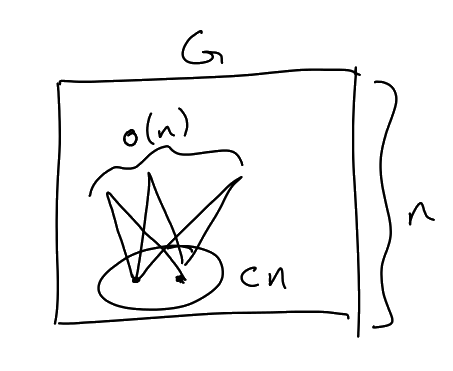
vertices. But this is impossible.
Proposition 6.11.
For all ,
there exists a graph
with edges so that
every set of size
contains some
with
common neighbours.
So we have to go back into the guts of the embedding idea. In some sense, the embedding algorithm was a little bit wasteful: for
example, we dumped
into the rich set without any clever choice.
The key idea to improve the previous bound will be to perform a more clever embedding algorithm that
requires a weaker notion of rich set. We want to use a weaker notion of rich set so that we can find large
linear size rich sets.
Definition 6.12 (Approximately -rich).
Let be a
graph. Say is
approximately -rich
if
|
|
Here we use the notation
|
|
Lemma 6.13.
Assuming that:
Then .
Lemma 6.14.
Assuming that:
Theorem 6.15 (Fox, Sudakov, Conlon).
Assuming that:
Remark.
This also improves our bound on :
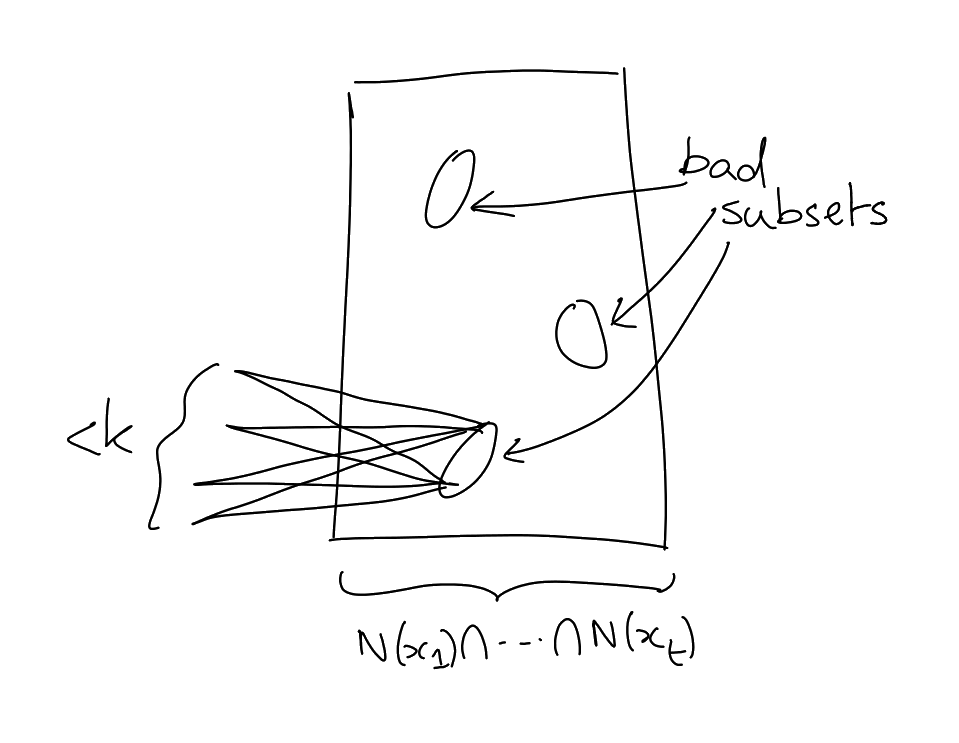
The key difference in proving Lemma 6.13 compared to the previous embedding algorithm is that we will need to embed
in a more clever way. We will
need to ensure that for all , the
neighbourhood of is not sent to
one of the bad subsets of (the
“bad” subsets are those which have
common neighbours).

Proof of Lemma 6.13.
For ,
, let
|
|
Say that is
healthy if
|
|
We will embed vertices of
one after the other. We will use this notion of healthiness to make sure that every time we place a
vertex, we keep plenty of good extensions.
Observation: If
is healthy, then the number of
such that
is not healthy is .
Proof of observation: Note
|
|
Let .
Then
But if , I
contradict that
is healthy. So we have proved the observation.
We now inject inductively.
Assume we have embedded
so far. We assume that we have
is healthy for all .
We now embed . Let
be the neighbour
of . We know
are healthy, so there are
at most (by observation)
ways of choosing
so that one of the neighbours becomes unhealthy. But there are only
neighbourhoods. So there
are choices that maintain all
healthy neighbours. Since ,
I can map
to a new vertex.
We now inject
exactly as we saw in the proof of Lemma 6.7. □
Proof of Lemma 6.14.
Let
be chosen uniformly at random. Let .
Let .
We have .
Let .
. Now
note that by Jensen,
|
|
So there is a
such that
So .
|
|
Theorem 6.16 (Graham, Rödl, Ruciński).
Assuming that:
Then there exists a constant
depending only on
,
such that
We will show
for some absolute constant .
Remark.
There exists
such that ,
for .
This is also “almost” the best bound known on these Ramsey numbers. The best known bound is
which was proved by Fox, Conlon, Sudakov.
Definition 6.17 ((p,eps)-dense).
Say that a graph
on
vertices
is -dense
if ,
, we
have
Lemma 6.18 (Embedding lemma for -dense graphs).
Assuming that:
Then .
Sketch of how to use embedding lemma: Apply lots of times, with say
. Get
lots of parts, with high density between all. Then can just greedily embed.
The lemma for greedily embedding will be:
Lemma 6.19.
Assuming that:
Then .
With the statements of these lemmas, we can already get an idea of where the
comes from. We will use
, so by Embedding lemma for
-dense graphs, we can always
either find a copy of , or zoom in
by a factor of to get a very dense
bipartite graph. We will apply this
times to get a highly dense graph, which we can then apply Lemma 6.19 to, and so we will need at least
vertices.
We now focus on discussing and proving Embedding lemma for
-dense
graphs.
Observation: Let
be a -dense
graph, and let
with and
. Then there
exists
such that
for all .
Proof.
Let .
Note
Hence
for all .
So we must have

Proof of Embedding lemma for -dense graphs.
The idea of the proof is to embed the vertices one by one. This could go wrong if we place vertices in
a way that reduces the possibilities for future vertices by too much. We avoid this issue by embedding
each vertex using the above Observation, to make sure that future vertices still have lots of valid places
to be embedded into.
Let . We
inductively map ,
. At each stage we maintain a
set of candidates for each .
In particular,
|
|
meaning after we have embedded ,
…, , we maintain that
after embedding
we have
We also require
where .
Say at step ,
I have mapped
preserving adjacencies and preserving ()
and ().
We now choose . We
want to choose .
Note
Let and
note
Now apply the observation with
and , where
, to find a
vertex
such that
as desired. □
Proof of Lemma 6.19.
Greedily embed
into . This is possible,
because when we embed ,
there are at least
many possible options (a lot!). □
Lemma 6.20.
Assuming that:
-
,
-
a graph with no
-dense
subgraph on
vertices
Then there exists
with
and
We will apply this Lemma with
and , so that we
get a subgraph
satisfying the assumptions of the greedy embedding algorithm (Lemma 6.19).
Proof.
We work by induction on .
For :
trivial, can just take ,
since .
Assume holds for .
Let
such that
where ,
because
is not -dense.
If then
let , so
|
|
Throw away vertices of degree
and we delete at most
of .
Call the resulting set ,
which is our desired set.
So we can assume that .
So we work with
and .
Fact: If I have a bipartite graph
with bipartition
and , then
there exists
with so
that
for all .
Proof: Let
chosen uniformly at random. Then
|
|
So if we let
be the set of vertices satisfying the desired condition, then we have
as desired.
Using this fact, we put
Let be
such that
and .
Now apply induction inside of
to find
with
and
Now consider the bipartite graph between
and .
Note
So apply fact to find
with and
. Now apply
induction inside of
to get
satisfying the induction hypothesis.
Set . We now check the max
degree condition. Let and
without loss of generality assume .
|
|
Then
as desired. □
This proof had some lies. At the end, we actually need to perform another step where we delete high degree
vertices. Also, for some of the inequalities, we treated them as equality so that we can divide by them nicely.
This can be fixed by passing down to a subgraph, because an average subgraph has the same density as the
original graph.
The proof is probably simpler if we instead make our inductive claim be about the density of
, and
then delete high degree vertices at the end to get a maximum degree condition.