1 The regularity lemma and applications
Theorem 1.1 (Szemerédi).
For all ,
there exists such that the vertex
set of any sufficiently large graph
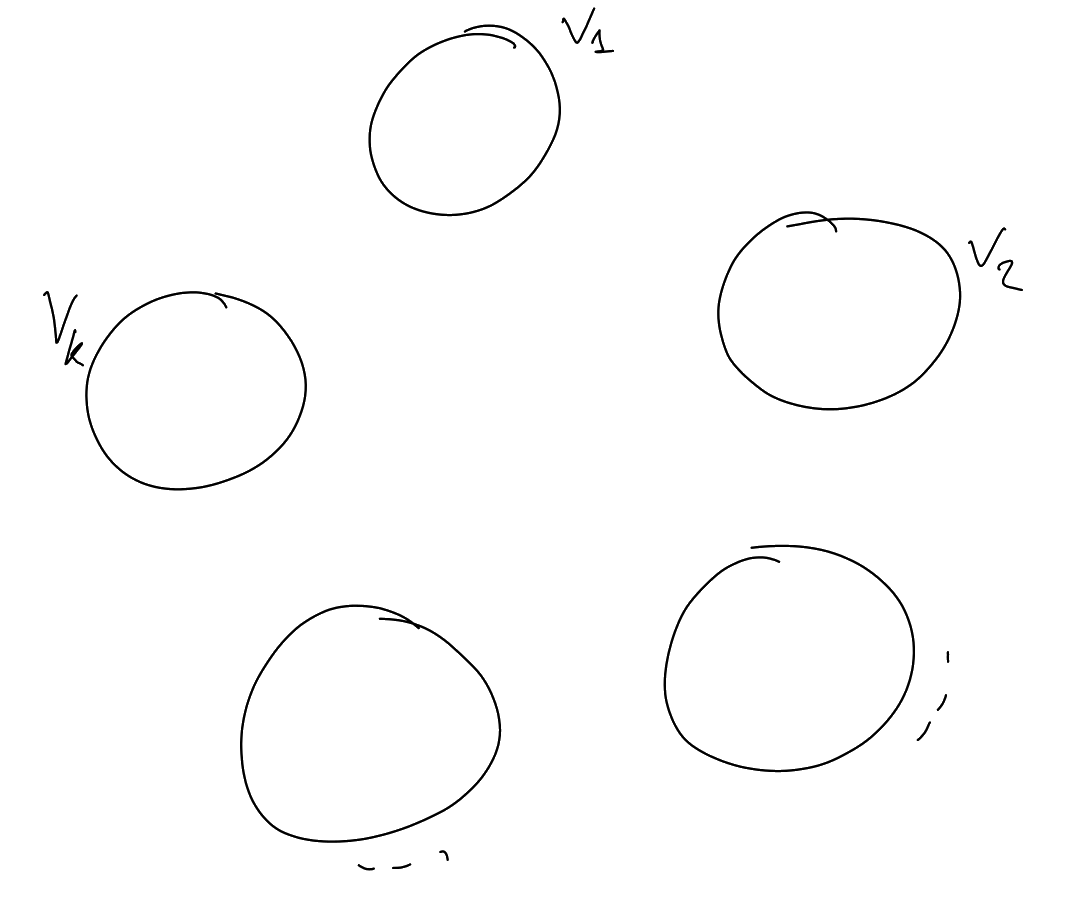
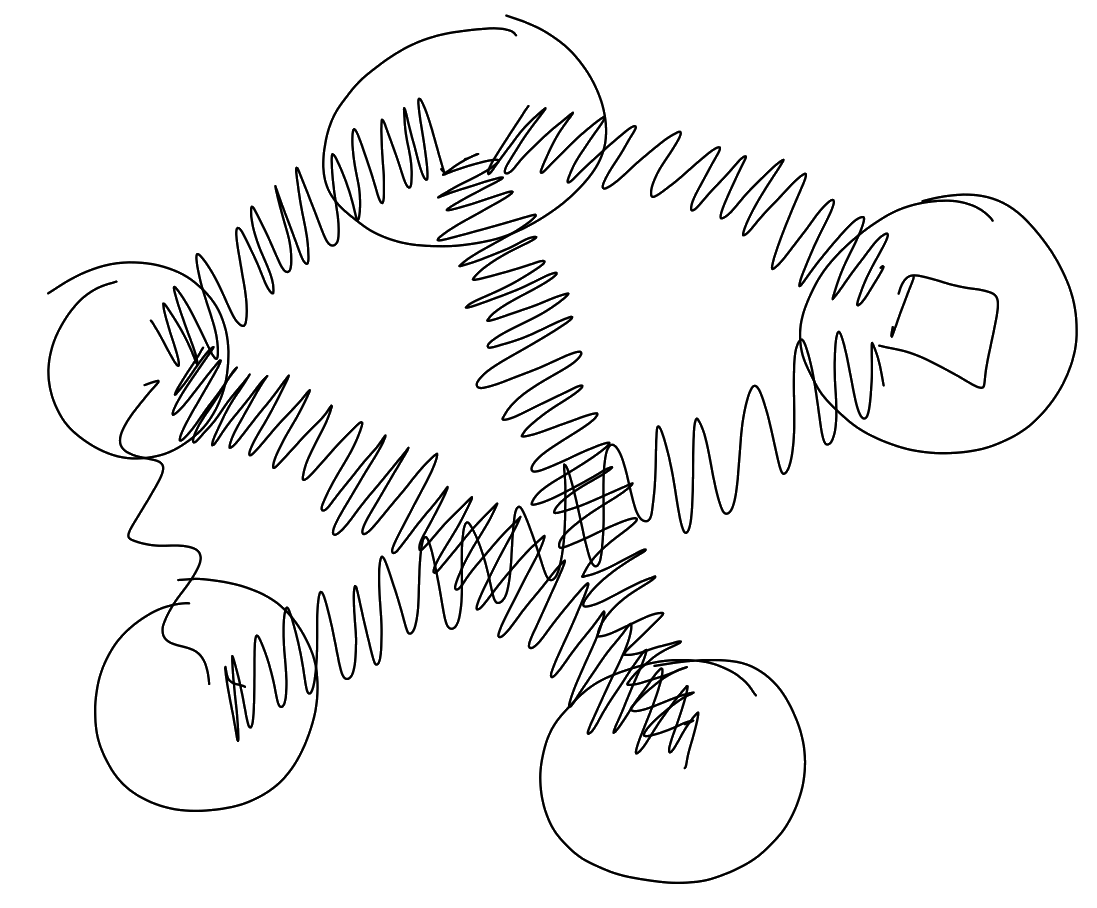
can be partitioned into ,
such that for all
but an -proportion
of pairs ,
is
-regular.
Remark.
-
-regular
means: looks like a “random” graph. We will define it more thoroughly at the end of the lecture.
-
In Theorem 1.1, it is also possible to ensure that all the
are almost the same size.
-
is known to have a
bad dependence on :
we have
where the tower of exponentials is of size .
Theorem 1.2 (Removal).
For all ,
there exists such that
the following holds. If is
a graph on vertices with
at most triangles, then
it is possible to remove
edges to make it triangle-free.
Sketch proof.
Apply Theorem 1.1 with
to obtain ,
of
almost equal size.
Remove all edges between
and where
fails to be
-regular, or where the
density of . The number of
edges removed in this way is .
Claim: The “reduced” graph is triangle-free.
Indeed, if form
a triangle in ,
then must
lie in
with ,
,
all regular and dense
(density ). Hence
we in fact have
triangles in . This
is a contradiction if .
□
Theorem 1.3 (Corners).
For all ,
there exists such
that for all , the
following holds. Let
of density
(). Then
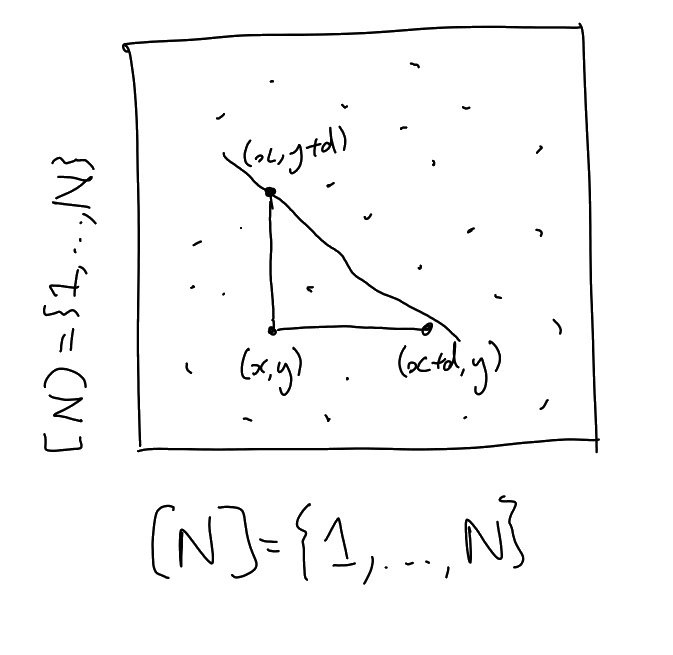
contains a triple
of the form ,
,
with
.
Remark.
The theorem as stated can be fairly easily deduced from a version where we only ask that
. To do this: note that if
is symmetric, then existence
of a triangle with implies
existence of one with .
Then one can “make
symmetric” (in exchange for a loss in density) by intersecting
with a
reflection of
through a suitably chosen point.
Proof.
Let
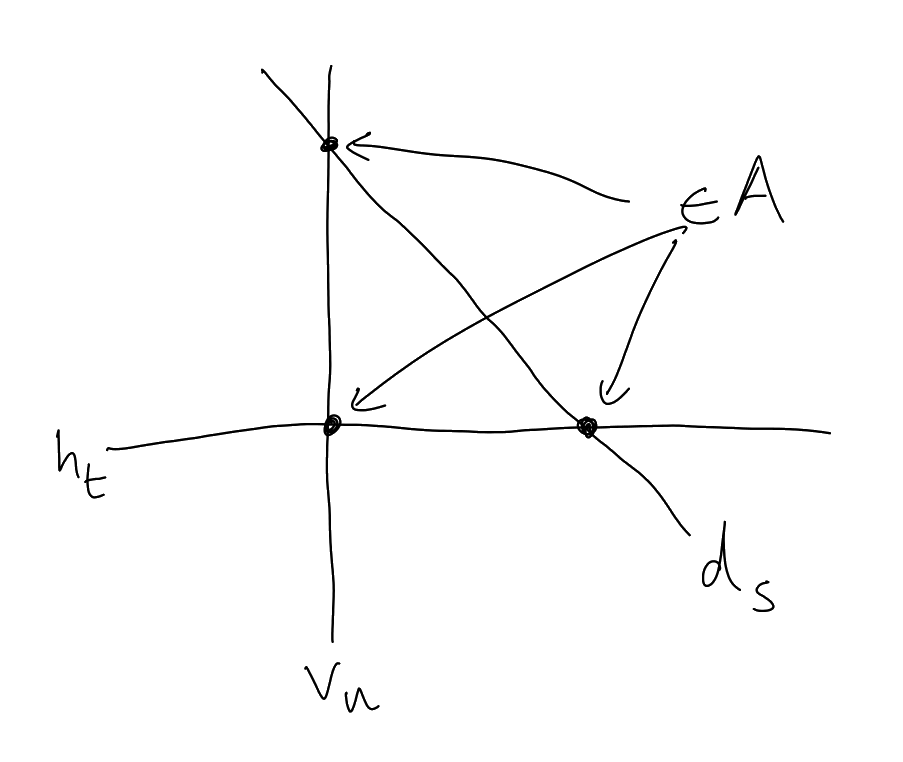
We define a tripartite graph on parts ,
where vertices are joined by an edge if and only if the intersection of the corresponding lines lies in
. A
triangle in this graph corresponds to three points
Setting , these
points are ,
,
.
If contains no
corner with ,
then the only triangles in this graph are the degenerate ones
(). There are
many of these, and they are
edge disjoint. Pick , then by
triangle-removal, there exists
such that we can destroy
triangles by removing at most
edges.
If , then
should be able to remove all triangles. But this is a contradiction since all the triangles are edge disjoint.
□
Theorem 1.4 (Roth).
For all ,
there exists such
that for all ,
every of
density
() contains a
non-trivial -AP
(a triple ).
Sketch proof.
Let .
By Theorem 1.3,
contains
with .
Then .
□
Proposition 1.5.
Let
be sets, and .
Then the following are equivalent:
-
(i)
For any pair of sets ,
,
|
|
where .
-
(ii)
For any two functions ,
,
|
|
-
(iii)
.
Definition 1.6.
Say
is -quasirandom
if Proposition 1.5(iii) holds with .
Say a graph
on
of density
is -quasirandom
if its balanced function 𝟙
is -quasirandom
(note that ).
Proposition 1.7 (Counting Lemma).
Let
be a tripartite graph on vertex sets .
Suppose are
-quasirandom,
with densities
respectively. Then
|
𝟙𝟙𝟙 |
Proof.
For example,
|
|
by (iii) (ii). Similarly for the
other terms, and hence we get .
We can improve it to by noticing
that of the terms are zero (any
of the terms of the form ).
□
Definition 1.8.
Suppose and
. Then the mean square density
(msd) of a bipartite graph
on
relative to this partition is
|
|
where
is the density of .
Example.
With respect to the trivial partition, .
Lemma 1.9.
Let be
a bipartite graph on of
density , and suppose it
fails to be -quasirandom.
Then there are partitions ,
such that
the of
relative to the
new partition is .
Proof.
Proposition 1.5(i)
(iii) provides us with ,
such
that
|
|
Let ,
.
The
relative to the new partition is
|
|
where
|
𝟙 |
Know: .
So
Note.
“Hypergraph” in these lectures will usually mean
-uniform
hypergraph.