7 Intersecting families
A family of
subsets of is
intersecting if for
every . Since we
can’t include both
and ,
for any intersecting
family . Equality
holds if for
some . If
is odd, another
example is . If
is even, we can
take and add in
exactly one of
and for
each .
There exist plenty of other extremal examples (e.g.
is extremal
for , then
is extremal
for ).
Notation.
,
.
What if we look at families of sets of size
for some given ?
If we can take
all of , so we
get . If
, we can take one
set from each
to get .
When ,
it gets more interesting.
Theorem 7.1 (Erdős–Ko–Rado Theorem).
Let
with
. Let
be an intersecting
family. Then , with
equality if and only if
is of the form .
Proof (Katona).
Let be an intersecting
family. We need to prove that if
is chosen uniformly, then
Let
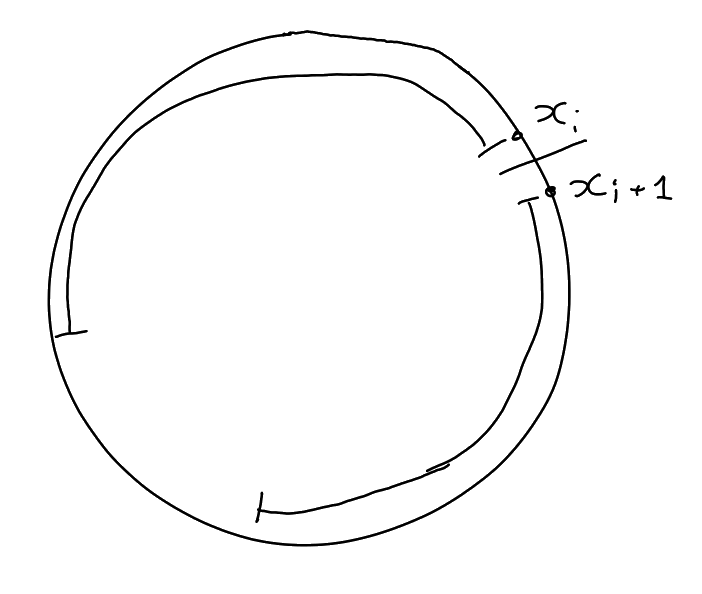
be a random cyclic ordering of .
An interval in this cyclic ordering is a set of the form
for some
(addition modulo ).
There are
intervals, so we will be done if we can prove that at most
of them belong to .
(That is because we can choose a random element of
by first choosing a random cyclic ordering and then choosing a random interval in that ordering.)
For each ,
let be the
interval and
let be the
interval .
Without loss of generality .
Then any other interval in
must be
or for some
. We can’t have
both. So at most
more intervals.
In the equality case, we must have equality for every cyclic ordering. In the above argument, we cannot have
with
and
. Therefore, if we
have sets, then there
must exist such that
the intervals are ,
together with . So
there exists such that
they all contain .
Now let us show that .
Without loss of generality
so our intervals are
for . Let
. Define
a cyclic ordering that goes like this:
In this cyclic ordering,
(sinc it is an interval in the other cyclic ordering). Next, note
.
So by the property we have proved (that in any cyclic ordering we have
consecutive
intervals),
since is
also an interval.
The proof is complete. □
Our aim now is to prove a theorem of Friedgut and Dinur that shows that if
and
is sufficiently large, then
for every intersecting family
of sets of size , there exists a
subset and an intersecting
family such that very few
sets in do not contain a
set in . “Very few” here
means relative to (rather
than being relative to ).
Note.
In this section, Boolean functions are from
to
, and the
-biased measure
gives probability
to and
to
.
Definition 7.2.
A Boolean function
is -quasirandom
if for every
of size , and
every ,
|
|
Notation.
Let .
Let
and let .
Define
by ,
where ,
.
Define the averaging projection
by , where
. Note that
depends only on
the coordinates in .
Lemma 7.3.
Each is an
orthogonal projection, and if ,
then .
Proof.
Since ,
we have , so
is a
projection. Now we would like to show that
for every ,
or equivalently that .
Since ,
it is enough to prove that
is self-adjoint.
But
This proves that
is self-adjoint, which is interesting property, but we in fact we didn’t need to
write down the last line in the calculation above if all we want to deduce is that
.
Now let
and let .
Write
where ,
,
.
Then
Lemma 7.4 (Regularity lemma for Boolean functions).
For every
, there exists some
such that for every
Boolean function ,
there exists
with such that
if is chosen
randomly (
randomly) from ,
then
|
|
Example.
Define
randomly with
and
Then
is not quasirandom, but the conclusion of the above lemma holds if we take
.
Proof.
For any , define the
mean-square density of
to be .. Note
that if ,
then
|
|
Suppose now that does not satisfy
the conclusion of the lemma. Let .
Then for any ,
. If
is not
-quasirandom,
then there exists
and some
such that
Let . Also,
. If we choose a
random element of ,
then it equals
with probability .
Therefore,
|
|
But
so the LHS is
so it equals
|
|
So
in this case.
Let .
Then
in this case.
Averaging over ,
we deduce that
|
|
i.e. .
We can now do an iteration. Start with .
At -th
stage, if
doesn’t work, then replace it by ,
using the argument just given, with .
At each stage, mean square density goes up by at least ,
so the process must terminate in a bounded number of steps. □
Lemma 7.5.
For every
and , there
exists and
such that if
is an
-quasirandom monotone
Boolean function from
to with
, then
.
Proof.
Suppose that . By the
Mean Value Theorem, there exists
such that
By the main corollary to the The Margulis–Russo formula (Corollary 6.10), it follows that .
By the -biased
Friedgut junta theorem, we can find a Boolean -junta
such that
and .
But by
monotonicity, so
(as long
as )
. Therefore
. Therefore,
there exists
such that
and . By
monotonicity, ,
so choosing ,
we have that
contradicting -quasirandom,
where .
□
Notation.
Let be a
family of subsets of .
Write , the upward
closure of .
Theorem 7.6 (Dinur, Friedgut).
For every
and , there exists
such that for every
intersecting family
of subsets of there
exists of size at
most and an
intersecting family
of subsets of
such that
Proof.
It is convenient to reformulate the statement in terms of Boolean functions. So call
intersecting if for all ,
.
Let
be a Boolean function and apply the regularity lemma with parameters
, where
is to be chosen.
That gives us of
size at most
such that if is
chosen -randomly
from ,
then
|
|
Define
by setting if
is
-quasirandom,
and
and
otherwise. Then
|
|
(This corresponds to the statement that .
𝟙,
𝟙.)
Note that
is an intersecting family and ,
so we may assume that
is monotone, and hence that each
is monotone. It remains to prove that
is intersecting. Let
such that .
Then
and
are -quasirandom
and .
By Lemma 7.5 for appropriate ,
it follows that .
By averaging, we can find
such that
and .
Since
is intersecting, there must exist
such that ,
so
is intersecting. □
Lemma 7.7 (The LYM inequality).
Let
and let .
Write
for .
Then .
Proof.
Let
and .
Define a bipartite graph by joining
to
if and only if .
Now pick a random edge. The probability that it joins
to
is exactly .
It is also at most .
So .
□
Definition 7.8 (Modified upper shadow).
Let ,
let ,
let
and let .
Define the modified upper shadow
to be .
Lemma 7.9.
Let
be as above. Let
and . Assume
that .
Then
Proof.
Pick a random pair
with ,
,
. Then
|
|
Also, the probability is at most .
The result follows. □
Corollary 7.10.
For every ,
, there exists
such that for
every and every
intersecting family
where , there
exists ,
, and an
intersecting family
of subsets of
such that .
Proof.
Suppose not. Let .
Then
has density .
Apply the Dinur, Friedgut Theorem to
to obtain
and an intersecting family
of subsets of
with .
Note that since ,
for
every .
Also, if ,
then
|
|
for
sufficiently large.
But (by law of total probability),
|
|
But ,
so this is a contradiction. □