3 The -adic
numbers
Recall that is the
completion of with respect
to . On Example Sheet
1, we will show that is a
field. We also show that
extends to
and the associated valuation is discrete.
Definition 3.1.
The ring of -adic
integers
is the valuation ring
Facts: is a discrete valuation
ring, with maximal ideal , and
non-zero ideals are given by .
Proposition.
is the closure of
inside . In
particular, is the
completion of
with respect to .
Proof.
Need to show
is dense in .
Note is dense
in . Since
is open, we
have that is
dense in .
Now:
|
|
Thus it suffices to show
is dense in .
Let ,
,
.
For ,
choose
such that .
THen
as .
In particular,
is complete and
is dense. □
Definition (Inverse limit).
Let
be a sequence of sets / groups / rings together with homomorphisms
(transition maps). Then
the inverse limit of
is the set / group / ring defined by
|
|
Define the group / ring operation componentwise.
Notation.
Let
denote the natural projection.
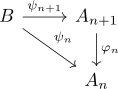
The inverse limit satisfies the following universal property:
Proposition 3.2 (Universal property of inverse limits).
Assuming that:
Then there exists a unique homomorphism
such that
.
Proof.
Define
Then implies that
. The map is clearly
unique (determined by )
and is a homomorphism of sets / groups / rings. □
Definition 3.3 (-adic completion).
Let be an
ideal ( a ring).
The -adic
completion of
is the
where
is the natural projection.
Note that there exists a natural map
by the Universal property of inverse limits (there exist maps
). We
say is
-adically
complete if it is an isomorphism.
Fact: .
Let be a non-archimedean
valued fieldand
such that .
Proposition 3.4.
Assuming that:
Then
-
(i)
Then
(
is -adically
complete)
-
(ii)
Every
can be written uniquely as ,
,
where
is a set of coset representatives for .
Proof.
-
(i)
is complete and
is closed, so
is complete.
impies
for all ,
and hence .
Hence
is injective.
Let
and for each ,
let
be a lifting of .
Then
so that .
Thus
is a Cauchy sequence in .
Let .
Then
maps to
in the .
Thus
is surjective.
-
(ii)
Exercise on Example Sheet 1. □
Corollary 3.5.
-
(i)
.
-
(ii)
Every element
can be written uniquely as
with ,
.
Proof.
-
(i)
It suffices by Proposition 3.4 to show that
Let be
the natural map
|
|
hence
is injective.
Let
and let
be a lift. Since
is dense in ,
there exists
such that
is open in .
Then ,
hence
is surjective.
-
(ii)
It follows from Proposition 3.4(ii) to
for some
□