6 Tube incidence implications of Fourier restriction

Last time: LOCALLY CONSTANT PROPERTY (think of it more as “heuristic”).

If supp⁡f^⊆B1 then

What if supp⁡f^⊆Bλ(0) (so |f|∼const on λ−1-balls)?

f=ˇ(f^φBλ)=f∗ˇφBλ,

where φBλ(ξ)=φB1(λ−1ξ).

ˇφBλ(x)=∫ℝne2πix⋅ξφB1(λ−1ξ)dξ=λn∫ℝne2πi(λx)⋅ξφB1(ξ)dξ=λnˇφB1(λx).

∗|ˇφB1| is approximately averaging over a 1-ball. ∗|ˇφBλ| is approximately averaging over λ−1-balls.

What about supp⁡f^⊆Bλ(v¯)?

Same thing happens, because eix⋅somethingf will have Fourier support in Bλ(0), and taking absolute values means we don’t notice the eix⋅something (modulation).

Returning to RPn−1∗(q′→p′)⟹RPn−1∗,loc(q′→p′).

∫BR|f(x)|p′dx≲∫BR|f(x)φBR(x)|p′dx

φBR(x)∈S(ℝn), |φBR|∼1 on BR, supp⁡φBR^⊆BR−1(0).

Last lecture →

∫IR−1(∫|ξ′|<1ξ′∈ℝn−1|f^∗φBR^(ξ′,|ξ′|2+ξn)|q′dξ′)≲(∗)(R−1)1−p′q′(∫ξ∈ℝn|f^(ξ)|q′dξ)p′q′.

Can choose φBR^ such that

Case 1: p′q′≤1. LHS of (∗) (using Hölder) is

≤|IR−1|1−p′q′(∫IR−1∫|ξ′|<1(|f^|∗|φBR^|1q′+1q(ξ′,|ξ′|2+ξn))q′dξ′dξn)p′q′∼|IR−1|1−p′q′(∫ℝn(|f^|∗|φBR^|(ξ))q′ddξ)p′q′≤(∫|f^|q′(ξ−η)|φBR^|(η)dη)1q′(∫|φBR^|qq)1q⏟∼1(Holder)≲|IR−1|1−p′q′(∫ℝn∫ℝn|f^|q′(ξ−η)|φBR^|(η)dηdξ)p′q′∼|IR−1|1−p′q′(∫ℝn|f^|q′(ξ)dξ)p′q′

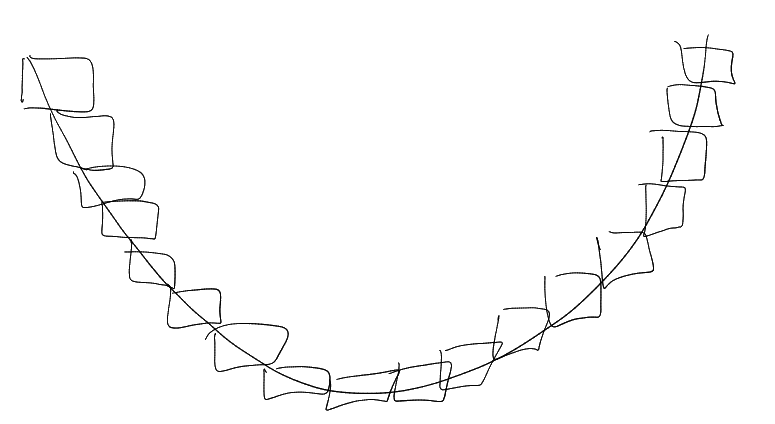
Case 2: p′q′>1. Use P1⊆ℝ2 for intuition.

PIC

Imagine a function g which is approximately constant on each R−1 cube Q. Think of g as g=∑⁡QgQ.

∫IR−1(∫|t|<1g(t,t2+ξ2)dt)p′q′dξ2.

Note

∫|t|<1g(t,t2+ξ2)dt∼gQ.

Therefore,

∫|t|<1g(t,t2+ξ2)dt∼C

if |ξ2|≤cR−1. (≤C for all ξ2∈IR−1).

|(P′+(0,ξ2))∩Q|∼R−1 for |ξ2|≤cR−1.

∼|IR−1|1−p′q+pq′Cp′q′=|IR−1|1−p′q′(|IR−1|C)p′q′(∫R−1∫|t|<1g(t,t2+ξ2)dtdξ2)p′q′

Important: locally constant property means we didn’t need p′q′<1, like before.

Make the intuition rigorous.

LHS of (∗)≲|IR−1|max⁡ξ2∈IR−1(∫|ξ′|<1(|f^|∗|φBR^|(ξ′,|ξ′|2+ξn))q′dξ′)p′q′

Consider the integral:

∫|ξ′|<1(|f^|∗|φBR^|(ξ′,|ξ′|2+ξn))q′dξ′=∫|ξ′|<1(∫ℝn|f^|(η)|φBR^|((ξ′,|ξ′|2+ξn)−η)dη)q′dξ′≤∫|ξ′|<1(∫ℝn|f^|q′(η)|φBR^|((ξ′,|ξ′|2+ξn)−η)dη)dξ′Same pointwise Holder∼Rn(R−1)n−1∫ℝn|f^|q′(η)dη∼R1∫ℝn|f^|q′≲(R−1)1⋅Rp′q′(∫|f^|q′)p′q′