3 Introduction to Fourier Transform
Correction for lecture 2: Number Theory Lemma.
True statements:
and .
See Terence Tao notes online.
Explaining :
,
such
that for
all .
We will be using to
mean “ but up to
sub-polynomial in ”.
Question:
|
|
For example, .
Recall:
means .
,
,
.
Reasonable conjecture?
Yes, reasonable.
Khinchin’s inequality: May select
so that
|
|
Constant integral: .
.
|
|
Warning.
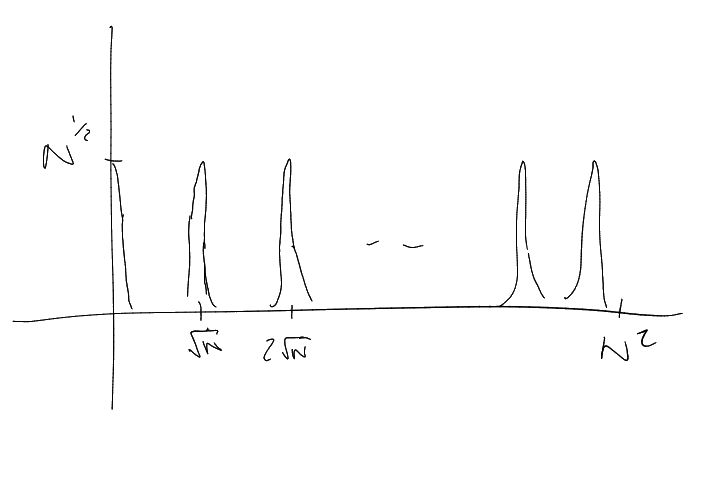
Enemy scenario:
(technically
if we want to satisfy the conditions mentioned above).
. Length
vector
with
many s.
Have:
|
|
We can calculate that the above expression is in fact
(which breaks the
conjecture until ).
It turns out that this is (roughly speaking) the only problem.
Why do we care?
,
. Then
|
|
|
|
Convex
sequences have minimal additive energy.
Decoupling doesn’t know how to take advantage of
.
3.1 Fourier Transform on
,
Schwartz
function:
for all .
is the spatial
variable, and
is the frequency variable.
Facts:
-
If ,
then .
-
Plancherel’s Theorem: ĝ.
-
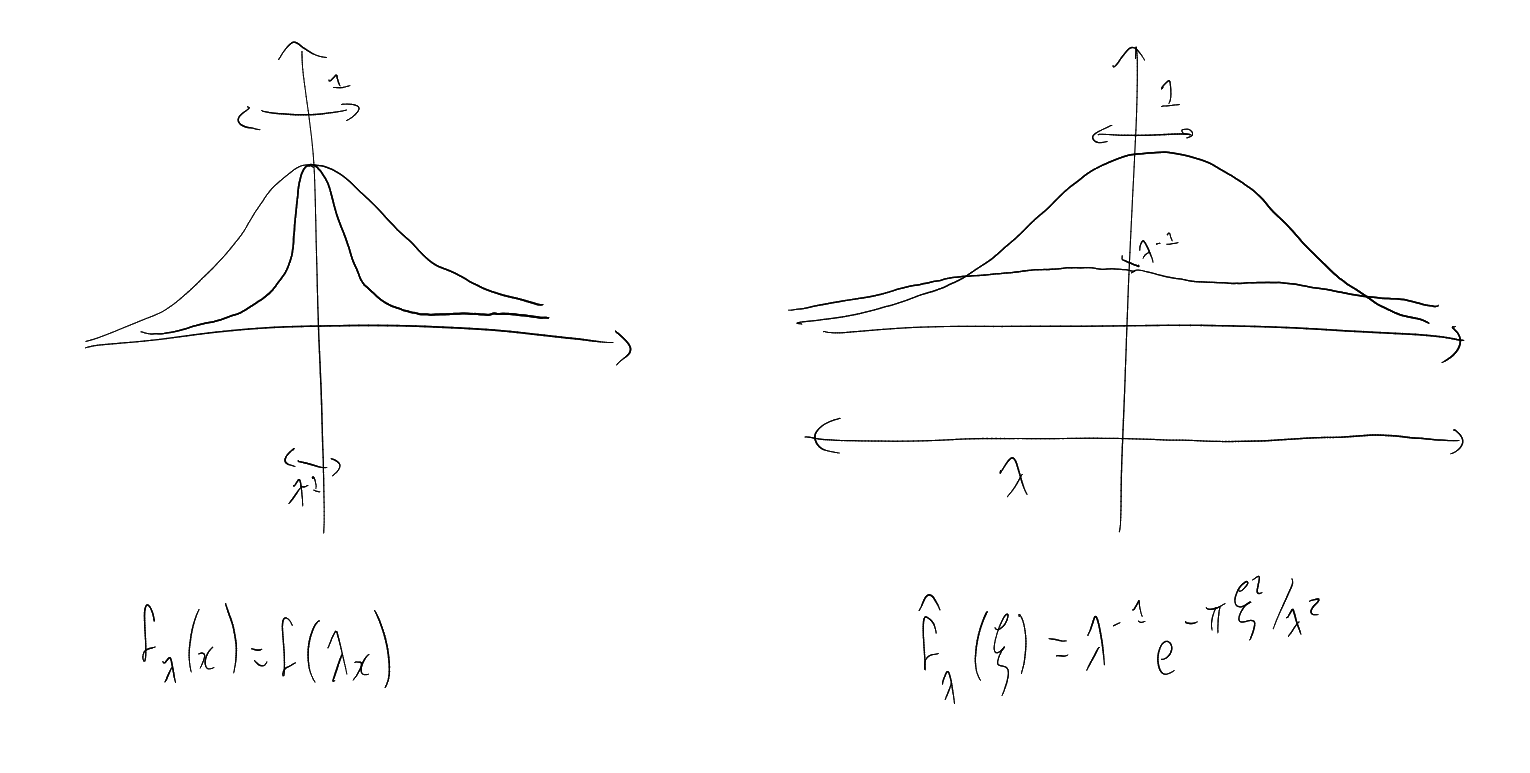
,
-
On the left: mass of is
smashed by a factor of . On
the right: the mass of is
stretched by a factor of ,
“ normalized”.
is independent
of .
There is a general formula for
where
is an affine transformation.
-
.
-
Translations are dual to modulations:
Basic question about :
to
boundedness?
Plancherel’s:
(isometry on ).
,
:
|
|
(contraction from
to ).
By interpolation (Marcinkiewicz):
for ,
(Hausdorff-Young inequality).
Are there any other
for which
Attempt 1: Let (compactly
supported smooth function on ),
with .
Consider .
Choose
so that
are not overlapping. Then
|
|
Also
|
|
We will use Khinchin’s inequality.
.