1 The Continuum Hypothesis

1398: Gödel showed Con⁡(ZFC)⟹Con⁡(ZFC+CH).

1962: Cohen showed Con⁡(ZFC)⟹Con⁡(ZFC+¬⁡CH).

Theorem (Hartogs’s Theorem). For every set X, there is a (least) cardinal α such that there is no injection from α to X.

We denote this by Hartogs’s aleph of X, ℵ(X).

Theorem. For every set X, there is no injection from P(X) into X. We denote this by 2|X|.

Using Axiom of Choice, well-order P(X) and get ordinal 2|X|.

We have

ℵ(X)≤2|X|.

Notation. Define:

ℵ0:=ℕℵα+1:=ℵ(ℵα)ℵλ:=⋃α<λℵαℶ0=ℕℶα+1=2ℶαℶλ=⋃α<λℶα

Clearly, ℵα≤ℶα.

Continuum Hypothesis (CH): ℵ1=ℶ1.

Generalised Continuum Hypothesis (GCH): ∀⁡αℵα=ℶα.

Why “continuum”?

Lemma. CH if and only if ∀⁡X⊆ℝ, X is uncountable ⟹ X∼ℝ (∼ means “there is a bijection”).

Proof.

Reminder:

Gödel showed Con⁡(ZFC)⟹Con⁡(ZFC+CH).

Cohen showed Con⁡(ZFC)⟹Con⁡(ZFC+¬⁡CH).

Relative consistency proofs.

By Completeness Theorem, this means:

If there is M⊨ZFC, then I can construct N⊨ZFC+(¬⁡)CH.

Analogy from algebra:

Lfields={0,1,+,⋅,−,−1}.

Axioms of fields: Fields.

Let φ2:=∃⁡x(x⋅x=1+1). Note ℚ⊨¬⁡φ2.

Idea: Start with ℚ and extend ℚ to get F⊨Fields+φ2.

Construct by algebraic closure (not in the usual sense – here we just mean adding in 2 and then adding everything else that this requires us to add).

Obtain ℚ(2)⊨Fields+φ2.

This is easy because everything that matters (Fields and φ2) is determined by equations; all formulas we need to check are atomic.

Definition 1.1 (absolute). If M⊆N and M,N are L-structures and φ an L-formula, then we say φ is absolute between M and N if for all x1,…,xm∈M,

M⊨φ(x1,…,xn)⟺N⊨φ(x1,…,xn).

If the ⇒ direction holds, then we say “upwards absolute”, and if the ⇐ direction holds, then we say “downwards absolute”.

Theorem (Substructure Lemma). All atomic formulas are absolute between substructures.

WHat if we have models of ZFC? Have

L∈={∈}.

No function symbols nor constant symbols. So: almost nothing is atomic.

M⊆N if and only if M is an L∈-substructure of N.

And: the formulas that we care about are definitely not atomic, but instead very complex.

Try to imagine a proof of:

If M⊨ZFC then there is N⊇M such that N⊨ZFC+CH.

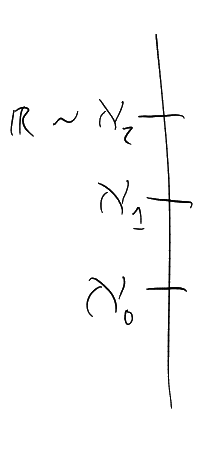
Without loss of generality M⊨¬⁡CH (else we are done). For simplicity, let’s consider the case ℶ1=ℵ2.

PIC

What can we do to “get rid of ℵ1”?

Maybe a surjection f:ℕ→ℵ1. Maybe we can form M[f]⊇M to get a smallest model M[f]⊨ZFC.

Clearly, in M[f], ℵ1M is not a cardinal anymore.

Does that show CH?

All sorts of things can happen

Assuming it is actually possible to form this smallest model M[f], there are lots of ways that this might not end up being enough to deduce CH. For example:

A fundamental problem of non-absoluteness

Consider φ∅(x):=∀⁡z(z∉x), which means “x is empty”.

Consider M⊨ZFC. Therefore there are e,e′ such that M⊨φ∅(e) and M⊨∀⁡z(z∈e′⟺z=e).

Consider N:=M∖{e}.

N is an L∈-substructure of M. But N⊨φ∅(e′), even though M⊨¬⁡φ∅(e′).

So φ∅ is not absolute between substructures.

Instead of substructures, we will restrict out attention to transitive substructures: in particular, to M transitive (∀⁡x,x∈M⟹x⊆M or equivalently x∈M∧y∈x⟹y∈M) such that M⊨ZFC.

Next time: theorems about absoluteness for transitive substructures.

Definition (Absolute formula). We say φ is absolute for M if for all x1,…,xn∈M, we have

M⊨φ(x1,…,xn)⟺φ(x1,…,xn) is true.

Clearly, if φ is absolute for M and absolute for N, then it’s absolute between M and N.

Cohen’s proof becomes:

If M is a countable transitive set such that M⊨ZFC, then there is a a countable transitive set N⊇M such that N⊨ZFC+¬⁡CH.