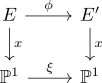
13 Heights
For simplicity, take .
Write
as
where
and .
Definition (Height of a point).
.
Lemma 13.1.
Assuming that:
Then there exist
such that for all
,
Proof.
Without loss of generality .
Upper bound: Write ,
coprime.
where
|
|
Therefore .
Lower bound: We claim that there exists
homogeneous of degree
and
such that
|
|
Indeed, running Euclid’s algorithm on
and
gives of
degree
such that
|
|
Homogenising and clearing denominators gives ()
for . Likewise
for .
Write
with
coprime. ()
gives
|
|
Therefore
divides .
|
|
where
|
|
Therefore
|
|
so
|
|
so
|
|
Notation.
For ,
, where
,
coprime.
Definition (Height of a point).
Let
be an elliptic curve, .
Define the height
Alsdefine logarithmic height
Lemma 13.2.
Assuming that:
Then there exists
such that
|
|
Note.
depends on
and , but
not .
Proof.
Recall (Lemma 5.4)
(
say).
Lemma 13.1 tells
us that there exists
such that
|
|
Taking logs gives
|
|
Example.
.
Then there exists
such that
Definition (Canonical height of a point).
The canonical height is
We check convergence:
Let .
Then
as . So the sequence
is Cauchy, ĥ
exists.
Lemma 13.3.
ĥ
is bounded for .
Proof.
Put
in above calculation to get
Take limit .
□
Lemma 13.4.
Assuming that:
Proof.
ĥ
bounded means we have a bound on
(by Lemma 13.3). So only finitely many possibilities for .
Each
gives
choices for .
□
Lemma 13.5.
Assuming that:
Then |
ĥĥ |
Proof.
By ?? 66, there exists
such that
|
|
Replace
by ,
divide by
and take limit .
□
Remark.
-
(i)
Case
shows that ĥ
(unlike )
is independent of the choice of Weierstrass equation.
-
(ii)
Taking
shows
|
ĥĥ |
Lemma 13.6.
Assuming that:
Then there exists
such that for all
with
,
we have
|
|
Proof.
Let have
Weierstrass equation ,
. Let
have
coordinates
. By Lemma 5.8,
there exists
of degree in
such
that
|
|
Write
with
coprime.
where
depends on ,
but not on
and .
□
Proof.
Lemma 13.6 and
bounded gives that there exists
such that
|
|
Replacing ,
by
,
, dividing by
and taking
the limit
gives
|
ĥĥĥĥ |
Replacing
by ,
and ĥĥ
gives the reverse inequality. Therefore ĥ
satisfies the parallelogram law, and hence ĥ
is a quadratic form. □
Remark.
For a
number field and ,
define
where the product is over all places ,
and the absolute values are normalised such that
Using this definition, all results in this section generalise when
is replaced by a
number field .