Probabilistic
Combinatorics
Lectured by Julian Sahasrabudhe
Contents
1 Introduction
The course is Probabilistic Combinatorics, being lectured by
|
|
We will be studying in particular the Ramsey numbers. Starting with the simplest to define:
|
|
Example.
:
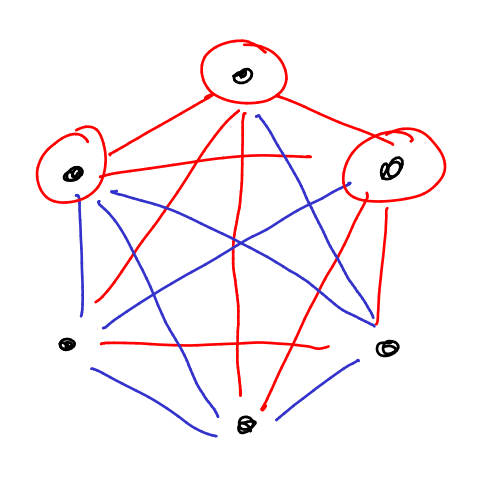
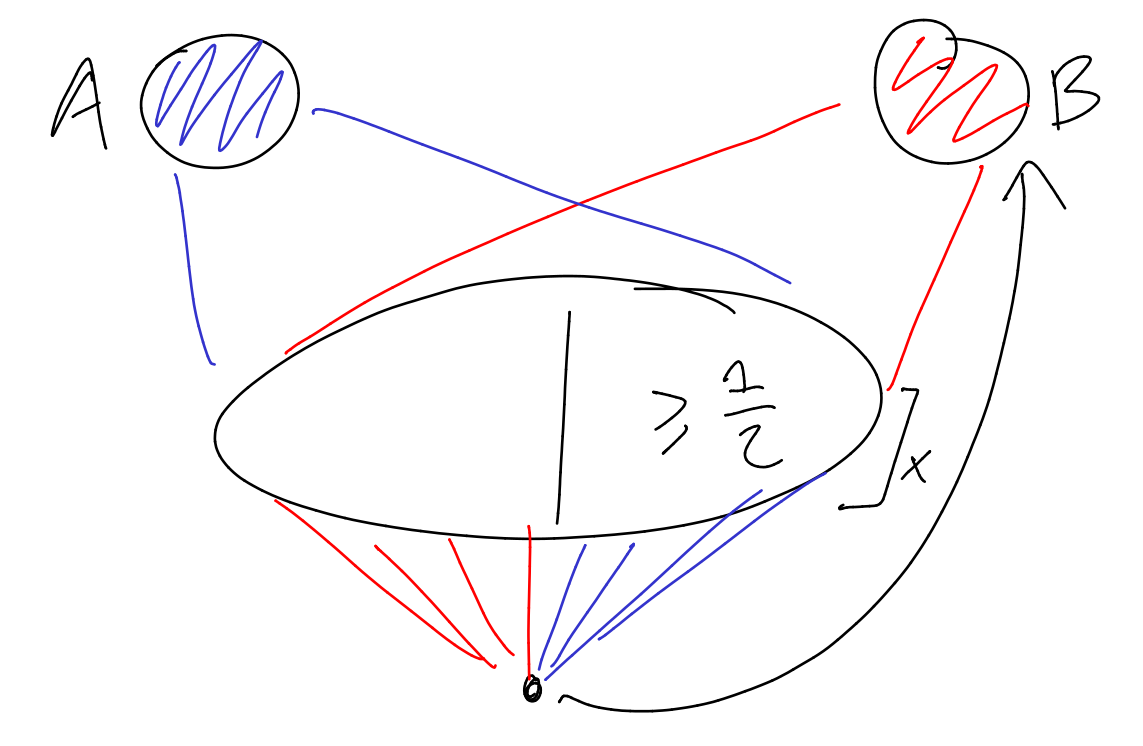
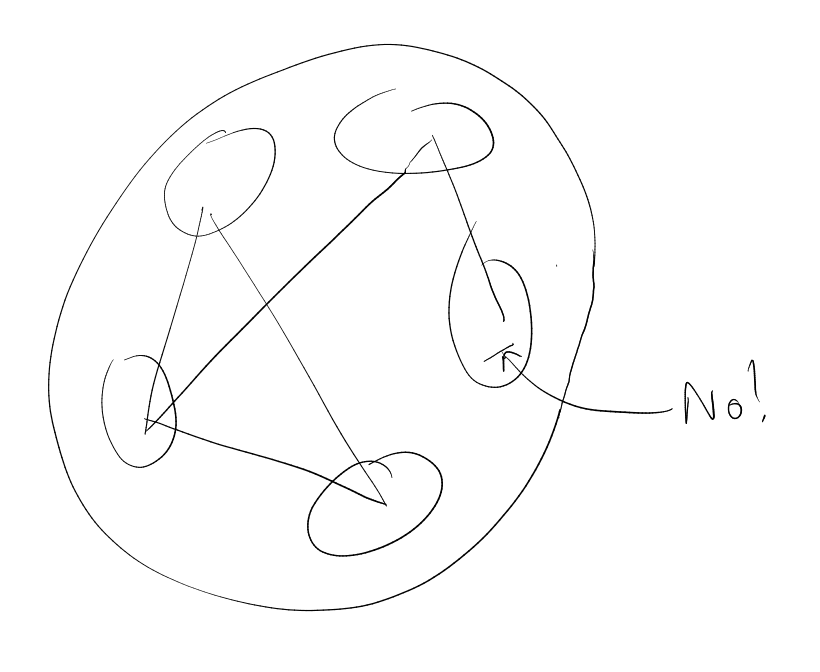
pick a vertex. Without loss of generality say it has at least 3 red neighbours. If any of these are connected by
a red edge, then we get a red triangle by using the original vertex. If none of them are connected by a red
edge, then we get a blue triangle between them.
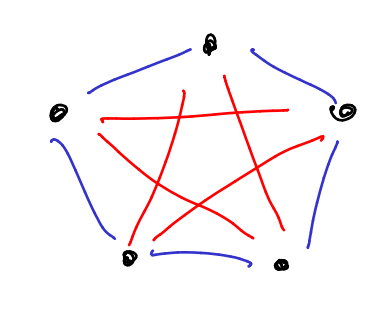
: by
considering the following picture.
Thus .
Main question: how fast does
as ?
We will also study:
|
|
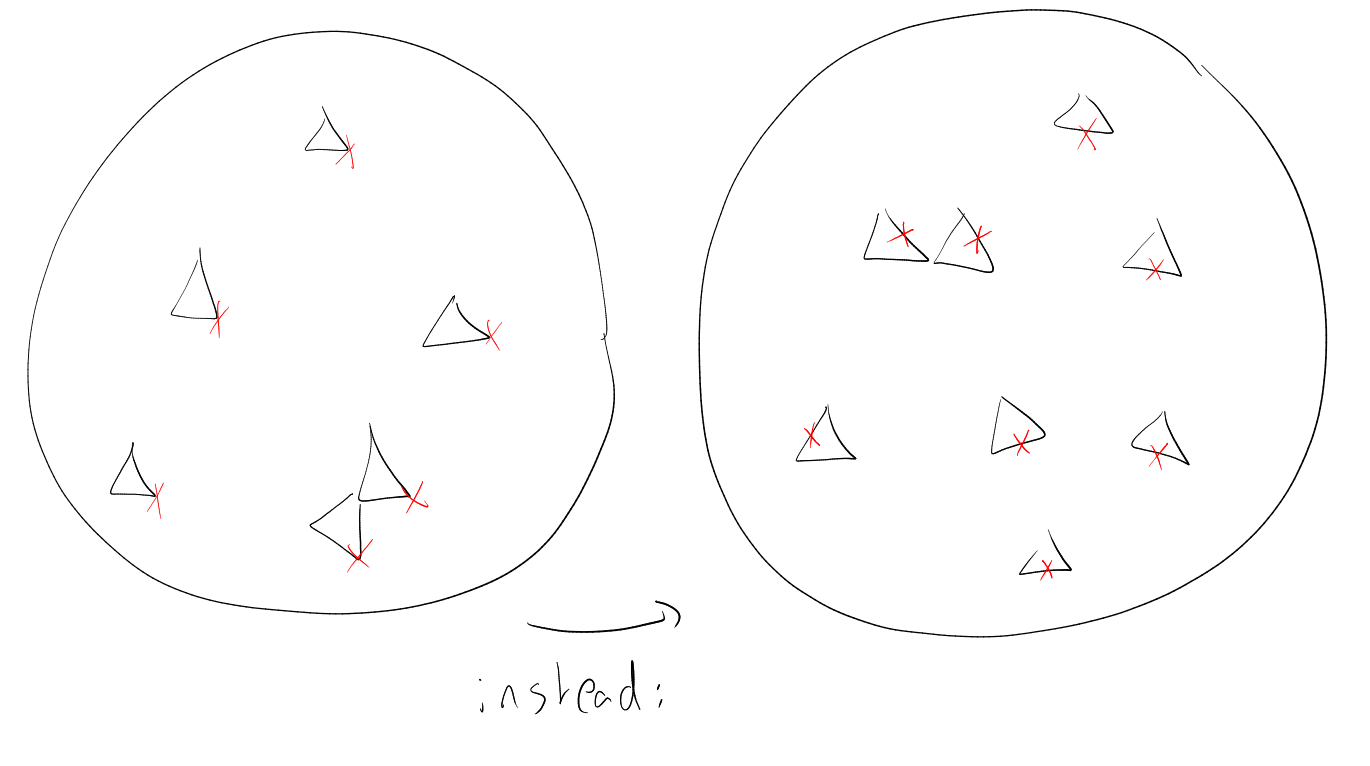
For a fixed graph ,
we define
|
|
For a
fixed graph, we define
|
|
Example.
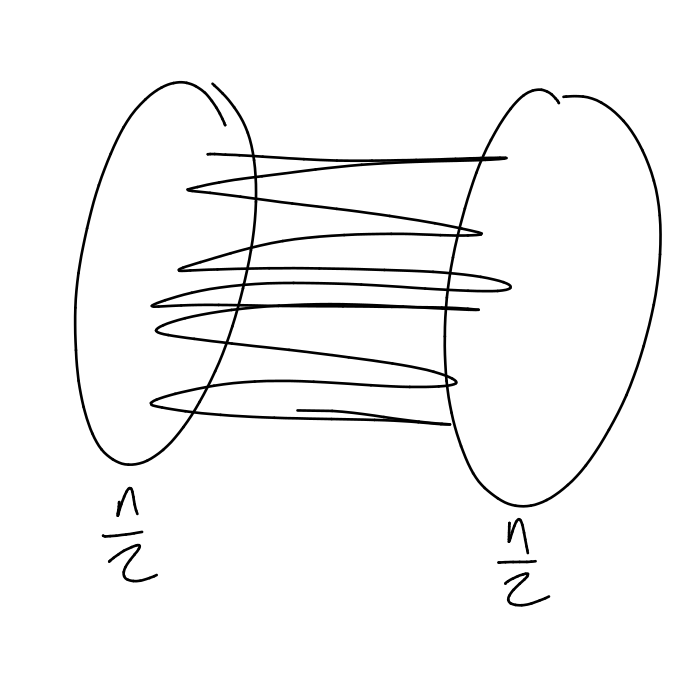
Mantel’s Theorem says that
1.1 Binomial Random Graph
Definition 1.1 (Binomial random graph).
Given ,
,
the binomial random graph
is the probability space defined on all graphs on
vertices, where each edge is included independently with probability .
1.2 Topics in this course
-
First examples: “first moment method”.
-
:
-
Dependent random choice:
-
Pseudo-randomness
-
Szemeredi-Regularity lemma
-
Method of graph containers:
1.3 Brief introduction to
Theorem (Erdos-Szekeres, ’35).
.
Proof sketch.
Let
and let be a
colouring of .
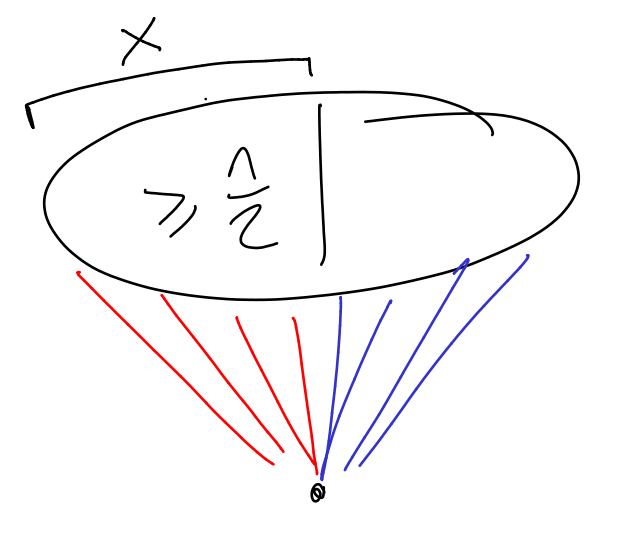
Pick a vertex .
It must have
neighbours connected to it by the same colour.
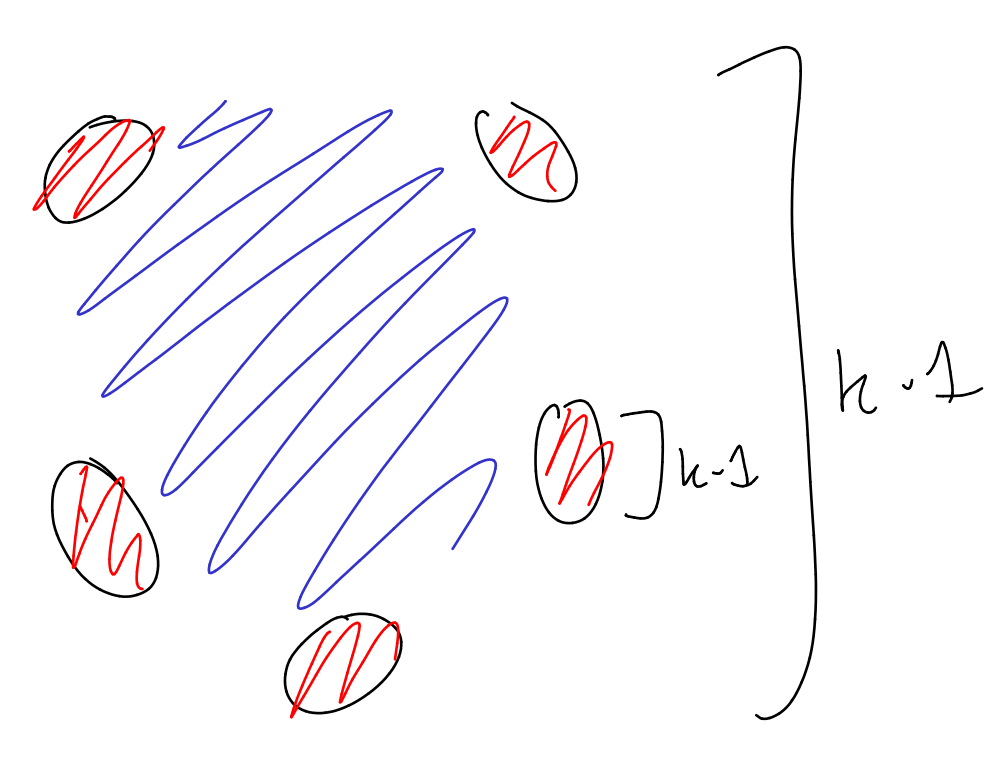
Now ignore everything that was connected using the other colour. Pick a new vertex from what remains, and
apply the process again:
We continue until either
or gets
to size .
We basically just want
i.e. .
□
How about a lower bound?
Example.
This gives . Quite
a long way from !
Theorem (Erdos, ’47).
.
Notation.
denotes
a quantity that
as .
Proof.
Let we
choose to be a
random colouring of
where the colour of each edge is chosen red / blue uniformly and independently. We have
by the choice of .
□
Big question: Is there an “explicit” construction that gives
, for some
fixed ?
2 The Ramsey numbers
Theorem (Erdos-Szekeres, 1935).
.
Proof.
Induction. See e.g. GT. □
Note.
.
Idea 1: If randomly colour ,
we have
triangles :(
Idea 2: We want to bias our distribution in favour of
– colour
“red”. Say .
Sad news: if
then contains
a with high
probability. :(
Theorem (Erdos, 1960s).
for some .
Proof sketch.
Sample ,
then define .
For this to work we need .
So .
So take .
□
Remark.
This is called the “deletion method”.
Fact (Markov). Let be a
non-negative random variable. Let .
Then
That is
for any .
Fact. For
we have
and
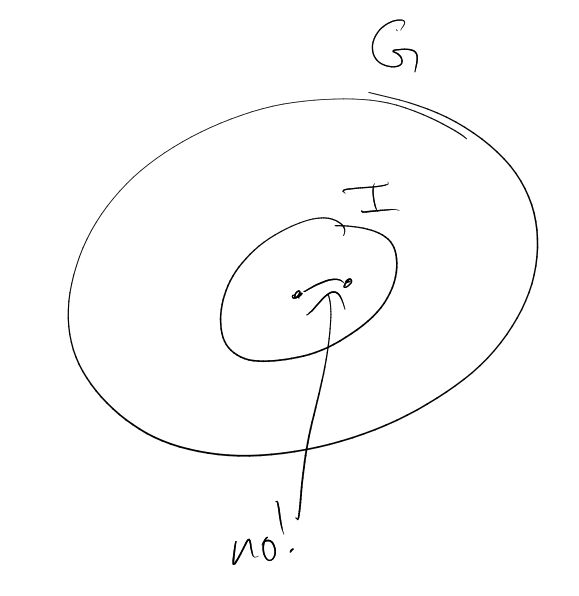
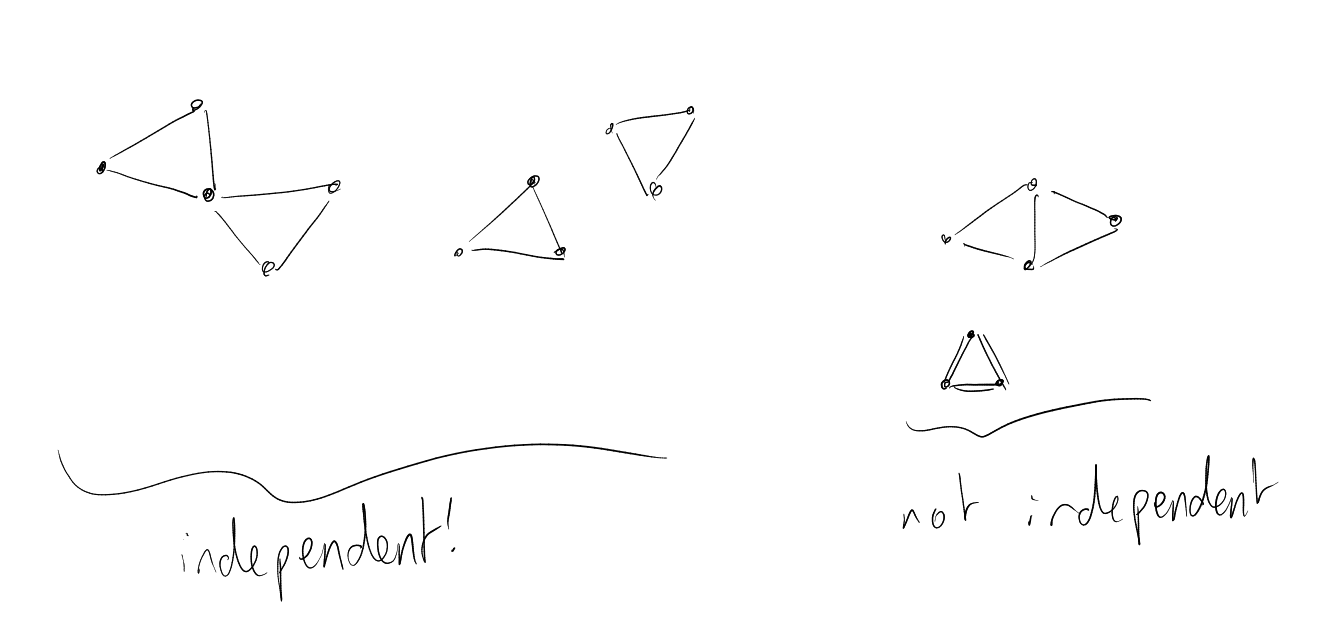
Definition 2.1 (Independence number).
Let
be a graph. Then
is independent if
in
for all .
We use .
Note.
We are trying to construct a triangle free graph on
vertices
with .
Lemma 2.2.
Assuming that:
Then |
|
with probability tending to
as
(known as “with high probability (w.h.p.)”).
Remark.
We actually have
in this lemma.
Proof.
Let ,
for some .
Let
be the random variable that counts the number of independent
sets in
.
by plugging in .
So by Markov
We have a method for bounding the probability that
is large: Markov
says that .
What about bounding the probability that it is small?
Fact: Let be a
random variable with ,
finite. Then
for all ,
|
|
Reminder:
|
|
Lemma 2.3.
Assuming that:
Then |
|
with high probability.
Proof.
Let
be the random variable counting the number of triangles in
. Note
Mean is straightforward:
Variance is a little more tricky. First:
|
|
We can write
Since the pairs of events are independent whenever
, we
have
Now note
□
Recall that before we showed that for ,
, we
have
|
|
with high probability.
Proof of lower bound on .
Set ,
. Let
and let
with a
vertex deleted from each triangle. Then with high probability we have
We also have with high probability:
So with high probability ()
and () hold. So there
must exist a graph on
with no triangles and
independence number
(actually not quite, but would have worked if we multiply one of the parameters by a constant or something).
□
Definition (Chromatic number).
Let
be a graph. The chromatic number of
is the minimum such
that there exists such
that no edge has both ends in the same colour.
denotes
the chromatic number.
Similar to the above lower bound on ,
Erdős proved:
Theorem (Erdős).
There exist graphs
with arbitrarily large chromatic number and arbitrarily large girth, i.e. for all
there exists
with
girth
and .
Idea: let’s delete an edge from each triangle, instead of a vertex (we have a lot more edges to spend than we
have vertices!).
For this we need
so . For
some small .
Danger: when we delete an edge from each triangle, we need to ensure that we don’t hurt
.
Theorem 2.4 (Erdos, 1960s).
for some .
To prove this, it is enough to prove for sufficiently large
that there exists a
triangle free graph on
vertices with
for some .
This is because we can set ,
and then get .
More sketching of the idea: we know .
What if ? Then there
must be an edge (because .
Not very impressive.
What if ? Then we actually
get a lot of edges: expect ,
and can guarantee .
Lemma 2.5.
Assuming that:
-
-
-
Then with high probability every set of size
in
induces
edges.
Proof.
Fix
and fix a set
with size .
for some .
We now union bound on all .
(using )
which
for .
□
Lemma 2.6.
Assuming that:
-
be a collection of events
-
,
for ,
be the event that t independent events of
occur
Then |
|
Remark.
.
We will use
for large in
the above lemma to get:
|
|
Proof.
Let .
Theorem.
Assuming that:
Then there exists a triangle-free graph
on
vertices with
Proof.
Let
be large. Let
for some .
Let ,
and let
be
with a maximal collection of edge disjoint triangles
removed, i.e. .
Clearly is triangle-free.
We let be the event
that every set of size ,
where contains
at least
edges. We now consider
|
|
So
|
|
We now union-bound
Define to be the collection of all
triangles that meet in at least
one edge, and define the event .
Note that the event ,
where , from the lemma
holds on the event that
meets
in
edges. This is where we use the fact that we only choose edge-disjoint triangles! By Lemma 2.6, we
have
So
|
|
if is chosen to
be small and
large. □
2.1 Lovasz-Erdős Local Lemma
Lemma 2.7 (Erdos-Lovasz, 70s).
Assuming that:
-
is a family of events in a probability space
-
-
,
where
is the max degree of
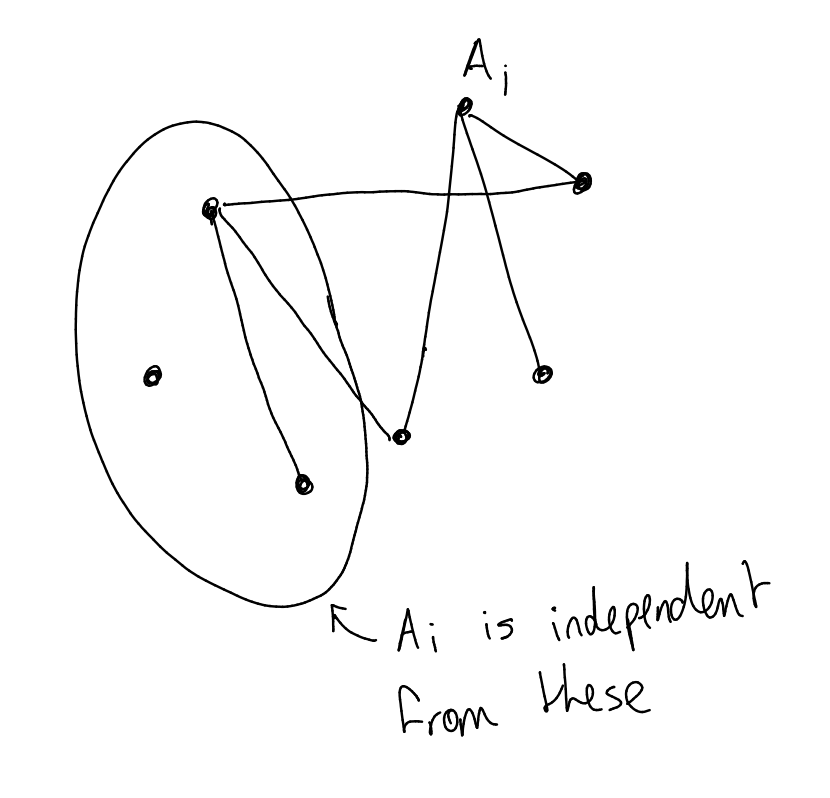
Definition 2.8 (Dependency graph).
If
is a family of events, a dependency graph
is a graph with vertex set ,
with the property that: for all ,
the event
is independent from .
Picture:
Reminder: is
independent from if
is formed by taking
intersections of ,
we have
Theorem (Spencer).
.
Proof.
Let and let
. Choose a colouring uniformly
at random. For every ,
define the event
|
|
We clearly have .
Let be the
dependency graph on
where if
.
|
|
We now check:
|
|
This .
So the condition in Local Lemma holds for sufficiently large .
□
Remark.
This is the best known lower bound for diagonal Ramsey.
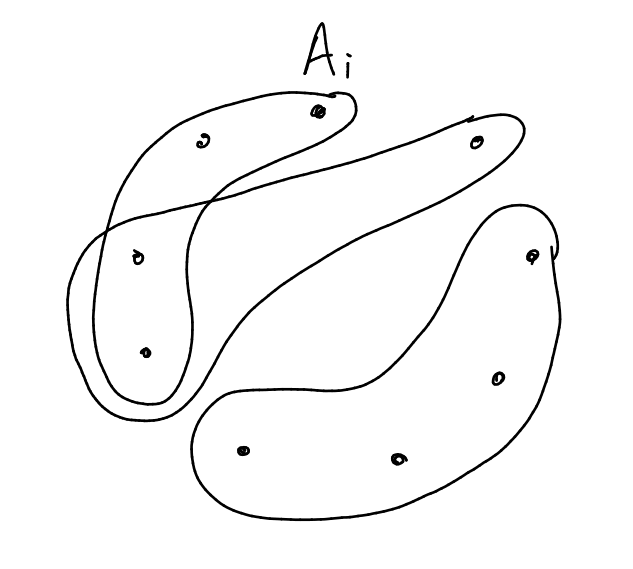
Definition 2.9 (-uniform hypergraph).
Say
is a -uniform
hypergraph on vertex set
if .
Definition 2.10 (Colourable -uniform hypergraph).
Say a -uniform
hypergraph is -colourable
if there exists
such that there is no monochromatic .
Theorem 2.11.
Assuming that:
Then is
-colourable.
Proof.
We choose our colouring of the ground set
uniformly at random. For each ,
define the event
We have . We want
. Note if we define our
dependency graph
by if
, then
Now just use the bound on
in the hypothesis. □
Remark.
Actually, our second application implies the first on
: just let
be the
-uniform
hypergraph on ,
defined by
Theorem 2.12 (Lopsided Local Lemma).
Assuming that:
Then |
|
Proof.
We use
Applying this many times, we have
We will prove that this term is
by instead proving the more general statement:
|
|
where . We prove
by induction on .
If , then
done by hypothesis.
If , then
define
|
|
Note that
Let be the events
in the intersection .
Then
If no events in the intersection, then we are already done. Otherwise, we may apply the induction hypothesis
to each term to get
|
|
Proof of Local Lemma.
Apply Lopsided Local Lemma with weights
for all .
We just need to check that the probability upper bounds in Lopsided Local Lemma hold.
By calculus, we have
Hence
Now we will see another proof of ,
in order to give some intuition as to what kind of situations are good for Local Lemma.
Proof of using Local Lemma.
Recall that it is enough to show that for sufficiently large ,
there exists a triangle -free graph on
vertices with .
Set ,
and sample
where ,
with
is chosen later.
Define the events:
-
For each ,
define
-
For each ,
define
|
|
Define the dependency graph :
-
for
if .
-
for
if .
-
for
if .
Now note:
-
The event
is
to
,
.
-
The event
is
to
,
.
-
The event
is
to
,
.
-
The event
is
to
,
.
We choose
for all
(“we want to make it a bit bigger than the probability of it occuring so that we can afford the product stuff”)
and for
all .
Then
for large enough .
We have ,
so
Note
|
|
First choose
small so , and
then choose ,
then done. □
2.2 Upper bounds on
Theorem 2.13 (Ajtai-Komlos-Szemeredi, 1980s + Shearer 80s).
.
Theorem 2.14 (Shearer, 1980s).
Assuming that:
Then |
|
where
as .
Remark.
If we take
and modify, for ,
one can show that there exist graphs with no triangles and
|
|
˙
Index
-colourable
dependency graph
independent
-uniform
hypergraph
Local Lemma