Suppose for the moment that
is
small, so that
is
locally small. Given
two
functors : the
first sends an object
to
, and
a morphism
to the diagonal of
The
second is the composite
|
|
where is a Yoneda
embedding. Then
and
define a natural isomorphism between these two.
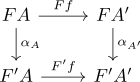
In elementary terms, this says that if ,
and is its image under
the diagonal, then
is the composite
|
|
This makes sense without the assumption that
is small, and it’s true since the composite maps
|
|
 The
second is the composite