7 Regular Categories

Definition 7.1 (Image, cover). We say a category C has images if, for every A→fB in C, there exists a least m:B′↣B in Sub⁡(B) through which f factors. We call m the image of f, and we say f is a cover if its image is 1B.

We write A⇾fB to indicate that f is a cover.

Lemma 7.2. Any strong epimorphism is a cover. The converse holds if C has equalisers and pullbacks.

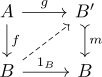
Proof. If f is strong epic, applying the definition to commutative squares of the form

           ′
 A       B

gfm1BB       B
shows that f is a cover.

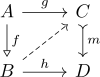
For the converse, a cover A→fB is epic since it can’t factor through the equaliser of any B⇉hgC with g≠h. To verify the other condition, suppose given

 A       C

gfmhB       D
then the pullback of m along h is monic by Lemma 4.15, and f factors through it, so it’s an isomorphism. So we get B→C by composing with the top edge of the pullback square. □

Here, if C has images, image facorisation defines a functor [2,C]→[3,C]: given

  A      B


fghk C      D
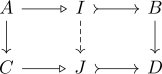
if we form the image factorisations
A      I       B

C      J       D
we get a unique I→J making both squares commute.

Definition 7.3 (Regular category). We say C is regular if it has finite limits and images, and image factorisations are stable under pullback, i.e. if the left hand square above is a pullback then so are both right hand squares. (This is equivalent to saying that covers are stable under pullback).

Example 7.4.

Proposition 7.5. Assuming that:

Then covers coincide with regular epimorphisms.

Proof.

  • ⇐ Regular epimorphism implies strong epimorphism by Exercise 21˙4.
  • ⇒ Suppose A⇾fB is a cover; let R⇉baA be its kernel-pair, i.e. the pullback of
             A


ffA       B
    Suppose given g:A→C with ga=gb; form the image A⇾e↣(h,k)B×C of A→(f,g)B×C. We’ll show h is an isomorphism, so that kh−1 is a factorisation of g through f. h is a cover since he=f is, so we need to prove h is monic.

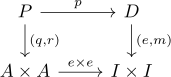
    Let D⇉mlI such that hl=hm; form the pullback

       P          D


p((eq,e,×rmeA)) × A      I × I
    e×e factors as A×A⇾1×eA×I⇾e×1I×I, so e×e is a cover, and p is a cover.

    Now fq=heq=hlp=hmp=her=fr so (q,r) factors through (a,b). But (h,k)ea=(f,g)a=(f,g)b=(h,k)eb and (h,k) is monic, so ea=eb, so eq=er, i.e. lp=mp. Also p is epic, so l=m. □

By a relation A↬B in a category C with finite products, we mean an isomorphism class of subobjects R↣A×B.

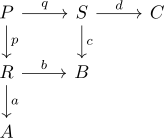
If C has images, we define the composite of A↬RB↬SC by forming the pullback

  P      S       C

  R      B


qpdcba A
forming the image of (ap,dq):P→A×C.

This is well-defined up to isomorphism and has the A↣(1A,1A)A×A as 2-sided identities.

Lemma 7.6. Composition of relations in C is associative if and only if C is regular.

Proof.

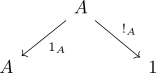
  • ⇒ Suppose given A→fB⇽eC. Consider the relations
             A              C               C


1fe11!CAAAA               B              C              1
    Composing the right hand pair first, we get
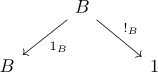
             B


1!BBB               1
    and thus we get
             A


1!AAA              1
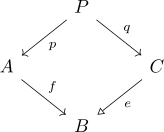
    Composing the left hand pair first, we begin by forming the pullback
             P

 A               C


pqfe        B
    and we endup with the image of (p,!P):P→A×1; so p must be a cover.
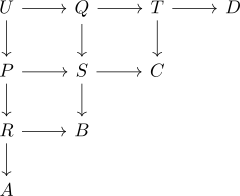
  • ⇐ Suppose given relations A↬RB↬SC↬TD. If we form the pullbacks
    U       Q       T       D


P       S       C

R       B


A
    then both T∘(S∘R) and (T∘S)∘R are the image of U→A×D. □

We write Rel(C) for the category whose objects are those of C and whose morphisms are relations. Note that Rel(Set) is just Rel as defined in Example 1.3(e).

We have a faithful functor C→Rel(C) which is the identity on objects and sends A→fB to A↣(1,f)A×B (for faithfulness, see Exercise 4.22(i)). We write f∙ for (1A,f).

Note that there’s an isomporphism Rel(C)→Rel(Cop) which is the identity on objects and sends R↣(a,b)A×B to R↣(b,a)B×A; we denote this by R∘, and write f∙ for (f∙)∘.

Also, Rel(C) is enriched over Poset (provided Rel(C) is locally small, i.e. C is well-powered), i.e. each Rel(C)(A,B) has a partial order which is preserved by composition.

We say A↬RB is left adjoint to B↬SA if 1A≤S∘R and R∘S≤1B.

Proposition 7.7. A↬RB is a left adjoint in Rel(C) if and only if it is of the form f∙.

Proof.

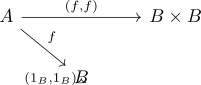
  • ⇐ We show (f∙⊣f∙): the composite f∙f∙ is just the kernel-pair R↣(a,b)A×A of f, and A↣(1A,1A)A×A factors through it. Also f∙f∙ is the image of
     A                 B × B


(ff(1,Bf,)1B)   B
    so it contains (1B,1B).
  • ⇒ Conversely, suppose R↣(a,b)A×B has a right adjoint R′↣(b′,a′)B×A. In forming R′∘R, we take the pullback
               ′
 P       R

ppb′bR′       B
    So the image of (ap,a′p′) contains A→(1A,1A)A×A, so ap factors as a cover followed by a split epimorphism, so a is a cover.

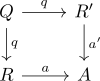
    Now, in the pullback

     Q       R ′


qqaaR′       A
    q and q′ are covers, but the image of (bq,b′q) is contained in (1B,1B) so bq=b′q′. But aq=a′q′, so R′=R∘, a=a′, b=b′ and q=q′. So a is monic, and hence an isomorphism, so R=(ba−1). □

P. Freyd developed a theory of allegories which have the structure of categories of relations and axiomatised those allegories A for which the subcategory Ala is regular.

In a regular category C, we say a relation R:A↬A is reflexive if 𝟙A≤R, symmetric if R∘=R, and transitive if R∘R≤R. R is an equivalence relation if it has all three properties. For any A→fB in C, the kernel-pair R→(a,b)A×A of f is an equivalence relation. We say an equivalence relation R is effective if it occurs as a kernel-pair, and C is effective regular if all equivalence relations are effective.

tfAbGp is regular but not effective regular: {(m,n)∈ℤ×ℤ|m≡n(mod2)} is a non-effective equivalence relation on ℤ.

Note that an equivalence relation is idempotent in Rel(C), and if A is an allegory and E is a class of symmetric idempotents in A then A[Eˇ] (as defined in Exercise 1.18) is an allegory; and if A is Rel(C) for a regular category C, then:

Proposition 7.8. Assuming that:

Then Ceff=(Rel(C)[Eˇ])la is effective regular, and the embedding Rel(C)→Rel(C)[Eˇ] restricts to a full and faithful regular functor C→Ceff which is universal among regular functors C→D where D is effective regular.

Note that if C is effective regular, its equivalence relations are split idempotents in Rel(C): if A↬RA is the kernel-pair of A⇾fB then it splits as f∙f∙ (as we saw for C=Set in Exercise 1.19).

Definition 7.9 (Topos). A topos is a regular category E for which the embedding E→Rel(E) sending f to f∙ has a right adjoint. We write the effect of the right adjoint on objects by A↦PA, and the unit A→PA as {}A, and the counit PA↬A as ∃⁡A↣PA×A.

In Set, PA is the power-set of A, the unit is the mapping a↦{a} of Example 1.7(c), and ∃⁡A={(A′,a)|a∈A′}⊆PA×A.

Note that (isomorphism classes of) subobjects of A are in bijection with morphisms 1→PA. C. J. Mikkelses showed that any topos has finite colimits; we’ll give Bob Paré’s proof, which is much simpler.

Proposition 7.10. Assuming that:

Then there exists a monadic functor Eop→E. In particular, Eop has finite colimits and if E has limits of shape J then it also has colimits of shape Jop.

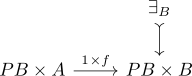
Proof. We make the assignment A↦PA into a functor P:E→E and a functor P∗:Eop→E: given f:A→B, Pf:PA→PB corresponds to the image of ∃⁡A↣PA×A→1×fPA×B, and P∗f corresponds to the pullback of

                 ∃B

1×f P B × A      P B × B
Given C→gPA corresponding to R↣C×A, (Pf)g corresponds to the image of R↣C×A→1×fC×B and similarly given S↣D×B, composing with P∗f corresponds to pulling back along D×A→1×fD×B.

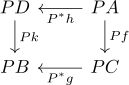
Given a pullback square

  D      A


hkfg B      C
in E,
  P D      P A


PPPPk∗f∗Phg B      P C
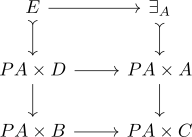
commutes, since both ways correspond to the image of the left vertical composite in
E            ∃A


P A × D      P A × A


P A × B      P A × C
where both squares are pullbacks.

Now, as in Example 5.14(d), we have that if E→eA⇉gfB is a coreflexive in E, then
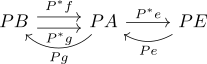
PPPPP∗∗∗gePfge B       PA       PE
is a split coequaliser coequaliser in E. Also, P∗ is self-adjoint on the right, and it reflects isomorphisms by Exercise 7.17(v). The second assertion follows from Proposition 5.8(i). □

Definition 7.11 (Support, totally supported, capital).

  • (a)
    By the support of an object A in a regular category, we mean the image of A→1. We say A is well-supported if A→1 is a cover.
  • (b)
    We say a regular category C is totally supported if every object is well-supported. We say C is almost totally supported if every object is either well-supported or a strict initial object, where we cann an object 0 strict if every A→0 is an isomorphism. (Given finite limits, a strict object is initial since for any A there exists 0→π−10×A→π2A, and the equaliser of any pair 0⇉A is a).
  • (c)
    We say a regular category C is capital if its terminal object 1 is a detector, i.e. C(1,∙) reflects isomorphisms.

Example. Gp and AbGp are totally-supported since their terminal objects are initial. Set is almost totally-supported and capital. Note that capital implies almost totally-supported since if A isn’t well-supported there are no morphisms 1→A.

A representable functor C(A,∙) always preserves limits, so it’s a regular functor if and only if A is cover-projective (c.f. Definition 2.10).

Lemma 7.12. Assuming that:

Then 1 is cover-projective.

Proof. Since covers are stable under pullback, we need to show that every A⇾1 is split epic. If A≅1, nothing to prove. If not, the projections A×A⇉A aren’t equal (since their coequaliser is A⇾1, by Proposition 7.5). So there exists 1→A×A not factoring through their equaliser, so there exists 1→A×A→A. □

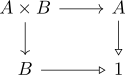
If C is regular, the full subcategory Cws of well-supported objects is closed under finite products since

A × B     A


B         1
is a pullback, and under pullbacks of covers since if A⇾B then A and B have the same support.

We write Ctv for the category obtained from Cws by adjoining a strict initial object 0: this is regular and almost totally-supported and the functor C→Ctv sending all non-well-supported objects to 0 is regular (c.f. Exercise 5.19).

Lemma 7.13. Assuming that:

Then there exists an isomorphism-reflecting regular functor I:C→C′, where C′ is also small and almost totally-supported, such that for every well-supported A∈ob⁡C there exists a morphism 1→IA in C′ not factoring through I(m) for any proper subobject m:A′↣A in C.

Proof. Recall from Exercise 7.17: C regular implies C∕A regular for any A, and for any f:A→B in C pullback along f defines a regular functor f∗:C∕B→C∕A, which has a left adjoint Σf:C∕A→C∕B sending g:C→A to fg. And f∗ reflects isomorphisms if and only if f is a cover.

We’ll define C′ as (C^)tv where C^ is easier to describe.

To satisfy the desired conclusion for a single well-supported object A, enough to take (!)A∗:C≅C∕1→C∕A, since (!A)∗A=(A×A→π2A) acquires a point Δ:(A→1A)→(A×A→A) not factoring through (A′×A→A) for any proper A↣A.

More generally, for any finite list A1,…,An of well-supported objects, we can take C∕∏⁡i=1nAi.

We define a base to be a finite list A→=(A1,…,An) of distinct well-supported objecs of C. We preorder the set B of bases by A→≤B→ if B→ contains all the members of A→. We write ∏⁡A→ for the product ∏⁡i=1nAi and if A→≤B→ we write πB→,A→ for the product projection ∏⁡B→→∏A→. This makes A→↦∏⁡A→ into a functor Bop→C.

Hence the assignment A→→C∕∏⁡A→, πB→,A→↦πB→,A→∗ is ‘almost’ a functor B→Cat.

We now define C^: its objects are pairs (B→,f) where B→ is a base and f:A→∏⁡B→ is an object of C∕∏⁡B→. Morphisms (B→,f)→(B→′,f′) are represented by pairs (C→,g) where C→ is a base containing B→ and B→′ and g:π∗f→π′∗f′ in C∕∏⁡C→, subject to the relation which identifies (C→,g) with (C→′,g′) if C→≤C→′ and the pullback of g to C∕∏⁡C→ is isomorphic to g′.

Clearly, each C∕∏⁡B→ sits inside C^ as a non-full subcategory; so in particular C≅C∕∏⁡[] is a subcategory of C^, C^ is regular, and the inclusions C∕∏⁡B→→C^ are isomorphism-reflecting regular functors.

Given a finite diagram in C^, we can choose B→ such that all edges of the diagram appear as morphisms in C∕∏⁡B→, and take the limit there, and this is a limit in C^. Similarly for images.

Also, if a morphism f becomes an isomorphism in C^, its inverse must live C∕∏⁡B→ for some B→, hence f is an isomorphism C∕∏⁡B→.

We define C′=(C^)tv: the induced functor C→C^→C′ is still isomorphism reflecting since C is almost totally-supported. □

Lemma 7.14. Assuming that:

Then there exists an isomorphism reflecting regular functor C→C^ where C^ is capital, small and regular. Hence in particular, there is an isomorphism-reflecting regular functor C→Set.

Proof. Consider the sequence

C=C0→C1→C2→⋯,

where each Cn+1 is obtained from Cn by the construction of Lemma 7.13.

We define C^ to be the pseudo-colimit of this sequence: objects are pairs (n,A) where A∈ob⁡Cn, and morphisms (n,A)→(m,B) are represented by pairs (p,f) where p≥max⁡{m,n} and F:IA→I′B in Cp, modulo the identification of (p,f) with (p′,f′) if p≤p′ and f′=If.

The proof that C is regular, and that the embeddings Cn→C^ are isomorphism-reflecting regular functors, is as in Lemma 7.13.

Given any non-invertible monomorphism A′↣A in C^, it lives in Cn for some n, so there exists 1→A in Cn+1 not factoring through A′↣A.

But if A→fB isn’t monic in C^, the legs R⇉baA of its kernel-pair aren’t equal, so there exists 1→rR not factoring through their equation, so 1⇉brarA are distinct but have the same composite with f.

So C^(1,∙) reflects monomorphisms and hence reflects isomorphisms. □

Theorem 7.15. Assuming that:

Then there exists a set I and an isomorphism-reflecting regular functor C→SetI.

Proof. Let I be a representative set of subobjects of 1 in C, and for each U∈I consider the composite

C→(!U)∗C∕U→(C∕U)tv→(C∕U)tv^→Set,

where the third factor is the functor of Lemma 7.14 and the fourth is represented by 1.

Given any non-invertible morphism A→fB in C, if U is the support of B then (!)H∗f remains non-invertible in C∕U and its codomain is well-supported there, so it remains non-invertible in (C∕U)tv and hence in Set.

So these functors collectively reflect isomorphisms. □

Remark 7.16.