10 Diagrams

Let N,M be L-structures.

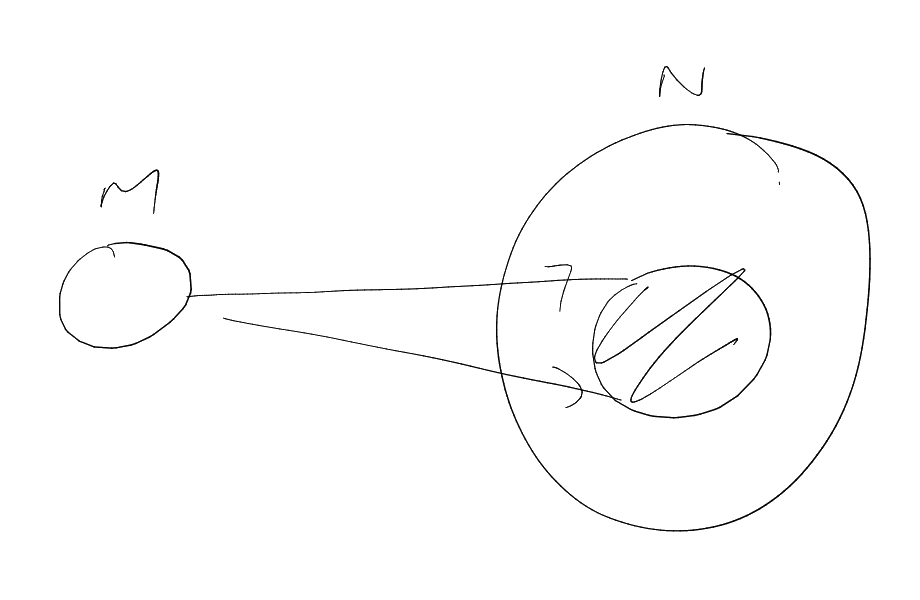
Remark 10.1. If h:M→N is an (elementary) L-embedding then after identifying a∈M with h(a)∈N we can view M as an (elementary) substructure of N.

PIC

Given A⊆M, let LA=L∪{a̲:a∈A} where a̲ is a new constant symbol. Then M is an LA-structure. Interpret a̲ as a.

Definition 10.2 (Diagram). The diagram of M (respectively elementary diagram), D(M), is the set of quantifier-free LM-sentences (respectively all LM-sentences) true in M.

Proposition 10.3. Assuming that:

  • M is an L-structure

  • N∗ an LM-structure such that N∗⊨D(M)

  • let N be the L-reduct of N∗ to L (means throw away LM∖L sentences)

  • define h:M→N such that h(a)=a̲=aN.

Then h is an L-embedding. Moreover, if N∗⊨ThM(M) then h is an elementary L-embedding.

Proof. We use Corollary 2.4. Let φ(x1,…,xn) be a quantifier-free L-formula, and fix a1,…,an∈M. Then

M⊨φ(a1,…,an)⟺φ(a1̲,…,an̲)∈D(M)⟺N∗⊨φ(a1̲,…,an̲)⟺N⊨φ(h(a1),…,h(an))

Therefore h is an L-embedding.

“Moreover” is similar. □

Remark. You can use this to show that any torsion free abelian group is orderable ( Example Sheet 2).