0 Review of First Order Logic
0.1 Languages
|
|
Example.
-
-
-
Convention: all languages include
0.2 Structures
Definition.
Given a language
|
|
Convention:
-
-
0.3 Formulas / sentences
-
Terms: made of variables, constant symbols and function symbols in a ‘sensible way’
-
Atomic formulas: Plugging terms into one relation symbol
-
Formulas:
-
Boolean combinations (
-
Quantifiers (
in a ‘sensible way’:
A formula with
-
Example.
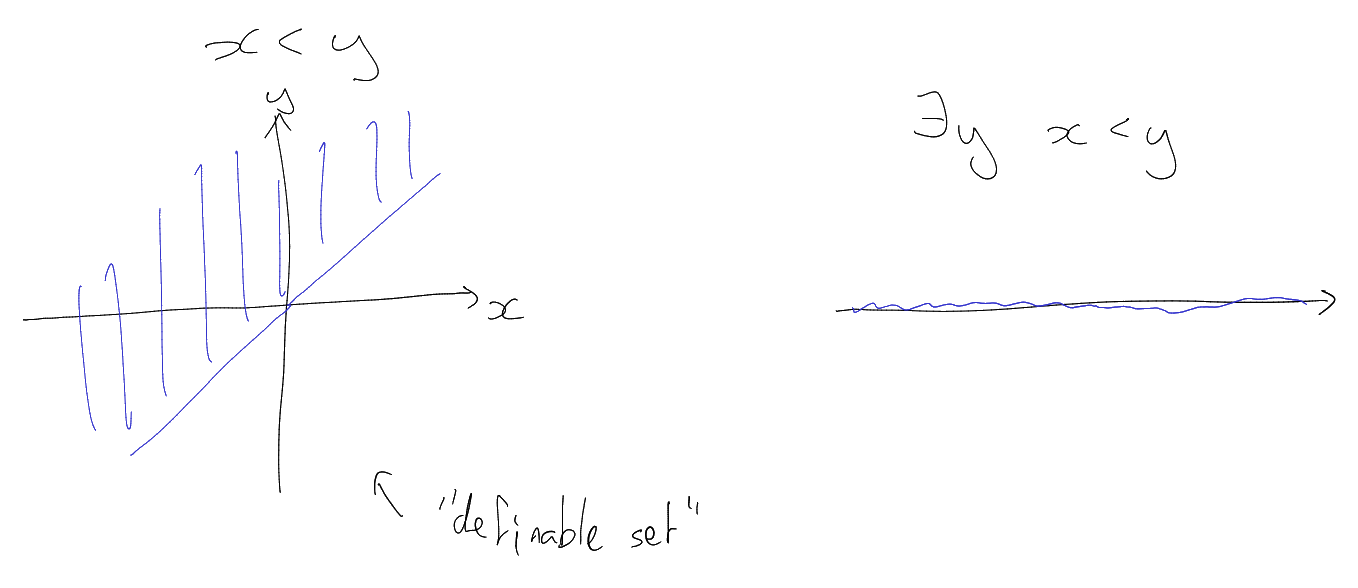
Formulas with no free variables are called sentences.
In an
-
True:
-
False:
In formula
Definition.
A set of sentences
Theorem (Compactness Theorem).
Let
(
Corollary (Upward Löwenheim Skolem). Any theory that has either:
-
arbitrary large finite models
-
at least one infinite model
has arbitrarily large models.