1 Estimating Primes

Theorem (Euler). ∑⁡p1p=∞.

Proof. Consider pN=∏⁡pN(1+1p+1p2+⋯+1pN), for N∈ℕ={1,2,3,…}. We have:

pN≥∑n=1N1n≥∑n=1N−1∫nn+1dtt=∫1N−1dtt=log⁡(N−1)

On the other hand, using 1+x≤ex, so

pN≤∏p≤N exp ⁡(1p+1p2+⋯+1pN)=exp⁡(∑p≤N(1p+1p2+⋯+1pN))≤exp⁡(∑p≤N(1p+1p2−p))≤exp⁡(C+∑p≤N1p)

Comparing these two bounds gives

∑p≤N1p≥ log ⁡ log ⁡(N−1)−C.

Then letting N→∞ gives the desired result. □

Theorem (Chebyshev’s Theorem).

π(x)≤cxlog⁡x

(for x≥2, where c is an absolute constant).

Proof. Consider

SN=2NN=(2N)!(N!)2

for N∈ℕ. We have

SN≤∑j=02N2Nj=(1+1)2N=4N.

On the other hand,

SN=∏p≤2Npαp(N)

where αp(N) is the largest j such that pj|2NN. We have αp(N)=1 for p∈(N,2N]. So

(log⁡4)N≥∑N<p≤2N log ⁡p.

Take N=⌈x2⌉, for x≥2. Hence

∑x<p≤2x log ⁡p≤( log ⁡4)⌈x2⌉+ log ⁡x≤( log ⁡4)x2+ log ⁡4+ log ⁡x.

Then

∑p≤x≤∑0≤j≤ log ⁡x log ⁡2(( log ⁡4)x2j+2+ log ⁡x)(telescoping summation, take x2,x22,x23,…)≤(log⁡4)x+( log ⁡x)2+1

So for x≥2 and a suitable large enough constant c′, we have

∑p≤x≤( log ⁡4)x+c′( log ⁡x)2.

Hence

∑x( log ⁡x)2<p≤x log ⁡p≤(log⁡4)x+c′( log ⁡x)2⟹log⁡x( log ⁡x)2(π(x)−π(x( log ⁡x)2))≤(log⁡4)x+c′( log ⁡x)2⟹π(x)≤x(log⁡x)2+(log⁡4)x log ⁡x( log ⁡x)2+c′( log ⁡x)2 log ⁡x( log ⁡x)2≤(log⁡4+𝜀)x log ⁡x

for any 𝜀, as long as x≥x(𝜀).

Take 𝜀=1. Choose c>0 large enough. □

1.1 Asymptotic Notation

Definition 1.1 (Big O and little o notation). Let f,g,h:S→ℂ, S⊆ℂ.

Write f(x)=O(g(x)) if there is c>0 such that |f(x)|≤c|g(x)| for all x∈S.

Write f(x)=o(g(x)) if for any 𝜀>0 there is x𝜀>0 such that |f(x)|≤𝜀|g(x)| for x∈S, |x|≥x𝜀.

Write f(x)=g(x)+O(h(x)) if f(x)−g(x)=O(h(x)) and write f(x)=g(x)+o(h(x)) if f(x)−g(x)=o(h(x)).

Definition 1.2 (Vinogradov notation). Let f,g,h:S→ℂ, S⊆ℂ.

Write f(x)≪g(x) or g(x)≫f(x) if f(x)=O(g(x)).

Example.

  • (log⁡x)100≪ exp ⁡( log ⁡x)≪x1100 (x≤1), since lim⁡x→∞( log ⁡⁡x)100 exp ⁡⁡( log ⁡⁡x)=0, lim⁡x→∞ exp ⁡⁡( log ⁡⁡x)x1100=0.

  • 100x+100≪x≪x100 (for x≥1).

  • ex=1+x+O(x2) for x∈[−10,10], since ex=1+x+∑⁡n=2∞xnn!.

  • ⌊x⌋=x+O(1) for x∈ℝ (since ⌊x⌋∈(x−1,x]).

  • x+1x=1+o(1) (for x≥1).

Lemma. Let f,g,h,u:S→ℂ.

  • (i) If f(x)=O(g(x)) and g(x)=O(h(x)), then f(x)=O(h(x)) (transitivity).
  • (ii) If f(x)=O(h(x)) and g(x)=O(u(x)), then f(x)+g(x)=O(|h(x)|+|u(x)|).
  • (iii) If f(x)=O(h(x)) and g(x)=O(u(x)), then f(x)g(x)=O(h(x)u(x)).

Proof. Follows from the definition in a straightforward way. Example:

  • (iii) |f(x)|≤c1|h(x)|, |g(x)|≤c2|u(x)|. Then |f(x)g(x)|≤c1c2|h(x)u(x)|, so f(x)g(x)=O(h(x)u(x)). □

1.2 Partial Summation

Lemma 1.3 (Partial Summation). Assuming that:

  • (an)n∈ℕ are complex numbers

  • x≥y≥0

  • f:[y,x]→ℂ is continuously differentiable

Then
∑y<n≤xanf(n)=A(x)f(x)−A(y)f(y)−∫yxA(t)f′(t)dt,

where for t≥1, we define

A(t)=∑n≤tan=∑n=1⌊t⌋an.

Proof. It suffices to prove the y=0 case, since then

∑y<n≤xanf(n)=∑0<n≤xanf(n)−∑0<n≤yanf(n).

Suppose y=0. By the fundamental theorem of calculus,

f(n)=f(x)−∫nxf′(t)dt=∫0xf′(t)𝟙[n,x](t)dt.

Summing over n≤x, we get

∑n≤xanf(n)=A(x)f(x)−∫0xf′(t)(∑n≤x𝟙[n,x](t)an)dt=A(x)f(x)−∫0xf′(t)A(t)dt□

Lemma. If x≥1, then

∑n≤x1n= log ⁡x+γ+O(1x),

where γ∈ℝ is Euler’s constant, which is given by γ=lim⁡N→∞∑⁡k=1N1k− log ⁡⁡N.

Proof. Apply Partial Summation with an=1, f(t)=1t, y=12. Clearly A(t)=⌊t⌋. Then,

∑n≤x1n=⌊x⌋x+∫1x⌊t⌋t2dt=x+O(1)x+∫1xt−{t}t2dt=1+O(1x)+log⁡x−∫1x{t}t2dt=1+log⁡x−∫1∞{t}t2dt+O(1x)

The last equality is true since ∫x∞{t}t2dt≤∫x∞1t2dt=1x.

Let γ=1−∫1∞{t}t2dt. Then we have the asymptotic equation as desired.

Taking x→∞ in the formula, we see that γ is equal to the formula for Euler’s constant, as desired. □

Lemma. For x≥1,

∑p≤x1p=∫1xπ(t)t2dt+O(1).

Proof. Apply Lemma 1.3 with an=𝟙ℙ(n) (where ℙ is the set of primes), f(t)=1t, and y=1.

We get A(t)=π(t), and then

∑p≤x1p=π(x)x+∫1xπ(t)t2dt=∫1xπ(t)t2dt+O(1)□

1.3 Arithmetic Functions and Dirichlet convolution

Definition (Arithmetic function). An arithmetic function is a function f:ℕ→ℂ.

Definition (Multiplicative). An arithmetic function f is multiplicative if f(1)=1 and f(mn)=f(m)f(n) whenever m,n∈ℕ are coprime.

Moreover, f is completely multiplicative if f(mn)=f(m)f(n) for all m,n.

Example.

  • f(n)=ns for s∈ℂ is completely multiplicative.

  • Möbius function

    μ(n)={1n=1(−1)kif n is a product of k distinct primes0n is divisible by a square of a prime

    This is multiplicative:

    • If μ(mn)=0 and m, n are coprime, then we must have had at least one of μ(m)=0 or μ(n)=0.

    • If μ(mn)=1, then say m is a product of k distinct primes and n is a product of l distinct primes. Then μ(mn)=(−1)k+l=(−1)k(−1)l=μ(m)μ(n).

    • τ(n)=∑⁡n=ab1 (divisor function) and τk(n)=∑⁡n=n1n2⋯nk1 (generalised divisor function). τ and τk are multiplicative.

On the space of arithmetic functions, we have operations:

(f+g)(n)=f(n)+g(n)(fg)(n)=f(n)g(n)(f∗g)(n)=Dirichlet convolution

Definition (Dirichlet convolution). For f,g:ℕ→ℂ, we define

(f∗g)(n)=∑d|nf(d)g(nd),

where ∑⁡d|n means sum over the divisors of n.

Lemma 1.4. The space of arithmetic functions with operations +, ∗ is a commutative ring.

Proof. Since arithmetic functions with + form an abelian group, it suffices to show:

  • (i) (f∗g)∗h=f∗(g∗h)
  • (ii) f∗g=g∗f
  • (iii) f∗I=f
  • (iv) f∗(g+h)=f∗g+f∗h

Proofs:

  • (i) Follows from (f∗g)(n)=∑⁡n=abf(a)g(b).
  • (ii) Follows from (f∗g)(n)=∑⁡n=abf(a)g(b).
  • (iii) Take
    I(n)={1n=10n≠0.

    Then one can check that f∗I=f.

  • (iv) From definition. □

Lemma. The set of arithmetic functions f with f(1)≠0 form an abelian group with operation ∗.

Proof. Need g such that f∗g=I.

(f∗g)(1)=f(1)g(1)=1⟹g(1)=1f(1).

Assume g(m) defined for m<n. We will defined g(n).

(f∗g)(n)=g(n)f(1)+∑d|nd≠1f(d)g(nd)⟹g(n)=−1f(1)∑d|nd≠1f(d)g(nd)⏟<n□

Lemma. Multiplicative arithmetic functions form an abelian group with ∗. Moreover, for completely multiplicative f, the Dirichlet inverse is μf.

Proof. For the first part, suffices to show closedness. Let f,g:ℕ→ℂ be multiplicative, and m,n coprime.

If mn=ab, we can write a=a1a2, b=b1b2 where a1=(a,m), a2=(a,n), b1=(b,m) and b2=(b,n). Therefore we have:

(f∗g)(mn)=∑mn=abf(a)g(b)=∑m=a1b1n=a2b2f(a1a2)g(b1b2)(above observation)=∑m=a1b1n=a2b2f(a1)f(a2)g(b1)g(b2)(by multiplicativity)=(f∗g)(m)(f∗g)(n)

(also need to check that inverses are multiplicative).

Now, remains to show that for completely multiplicative f, f∗μf=I.

Note that f∗μf is multiplicative by the first part. So enough to show (f∗μf)(pk)=I(pk) for prime powers pk. Calculate:

f∗μf(p)=f(p)+μf(p)=f(p)−f(p)=0=I(p)

and for k≥2:

f∗μf(pk)=f(pk)+μf(p)f(pk−1)=f(pk)−f(p)f(pk−1)=f(p)k−f(p)f(p)k−1=0=I(pk)□

Example. τk(n)=∑⁡n=n1⋯nk1. Then

τk=1∗1∗⋯∗1⏟k times.

So τk is multiplicative by the previous result.

Definition (von Mangoldt function). The von Mangoldt function Λ:ℕ→ℝ is

Λ(n)={log⁡pif n=pk for some prime p0otherwise

Then log⁡=1∗Λ since

log⁡n= log ⁡∏p|npαp(n)=∑p|nαp(n) log ⁡p=1∗Λ(n).

Since μ is the inverse of 1, we have

log⁡∗μ=1∗Λ∗μ=Λ∗1∗μ=Λ∗I=Λ.

1.4 Dirichlet Series

For a sequence (an)n∈ℕ, we want to associate a generating function that gives information of (an)n∈ℕ. Might consider

(an)n∈ℕ↔∑n=1∞anxn.

If we do this, then ∑⁡pxp is hard to control. So this is not very useful.

The following series has nicer number-theoretic properties:

Definition (Formal series). For f:ℕ→ℂ, define a (formal) series

Df(s)=∑n=1∞f(n)n−s

for s∈ℂ.

Lemma. Assuming that:

  • f:ℕ→ℂ satisfying |f(n)|≤no(1)

Then Df(s) converges absolutely for Re⁡(s)>1 and defines an analytic function for Re⁡(s)>1.

Proof. Let 𝜀>0 (fixed), n∈ℕ and Re⁡(s)>1+2𝜀.

Then

∑n=N∞|f(n)n−s|=∑n=N∞|f(n)|n−Re⁡(s)≪∑n=N∞n𝜀−Re⁡(s)≤∑n=N∞n−1−𝜀≤N−1−𝜀+∑n=N+1∞∫n−1nt−1−𝜀dt≤N−1−𝜀+∫N∞t−1−𝜀dt≪N−𝜀

Hence we have absolute convergence for Re⁡(s)>1+2𝜀. Also, Df(s) is a uniform limit of the functions ∑⁡n=1Nf(n)n−s. From complex analysis, a uniform limit of analytic functions is analytic. Hence Df(s) is analytic for Re⁡(s)>1+2𝜀.

Now let 𝜀→0. □

Theorem (Euler product). Assuming that:

Then
Df(s)=∏p(1+f(p)p2+f(p2)p2s+⋯),

for Re⁡(s)>1. Furthermore, if f is completely multiplicative, then

Df(s)=∏p(1−f(p)ps)−1,

for Re⁡(s)>1.

Proof. Let N∈ℕ, Re⁡(s)=σ>1. Let

Df(s,N)=∏p≤N(1+f(p)ps+f(p2)p2s+⋯).

Note that the series defining the factors are absolutely convergent, since

∑k=1∞|f(pk)||pks|≪∑k=1∞1pks<∞

(geometric series).

Therefore, multiplying out,

Df(s,N)=∑n=1∞a(n,N)f(n)n−s

where

a(n,N)=#{ways to write n as a product of prime powers, where the primes are ≤N}.

The fundamental theorem of arithmetic tells us that a(n,N)∈{0,1} and a(n,N)=1 for n≤N.

Now,

|Df(S)−Df(s,N)|≤∑n=N+1∞|f(n)||n−s|≪∑n=N+1∞n−σ→N→∞0

(since ∑⁡n=1∞n−σ<∞). Hence Df(s)=lim⁡N→∞Df(s,N).

Finally, for f completely multiplicative, use geometric formula:

∑k=1∞f(p)kpks=11−f(p)ps.□

Lemma. Assuming that:

  • f,g:ℕ→ℂ

  • |f(n)|,|g(n)|≤no(1)

Then
Df∗g(s)=Df(s)Dg(s)

for Re⁡(s)>1.

Proof. We know Df(s) and Dg(s) are absolutely convergent, so can expand out the product.

Df(s)Dg(s)=∑a,b=1∞f(a)g(b)(ab)−s=∑n=1∞∑n=abf(a)g(b)n−s=∑n=1∞(f∗g)(n)n−s=Df∗g(s)□

Definition (Riemann zeta function). For Re⁡(s)>1, define

ζ(s)=∑n=1∞n−s.

Example.

  • ∑⁡n=1∞τ(n)ns=ζ(s)2 for Re⁡(s)>1 (since τ=1∗1).

  • ∑⁡n=1∞μ(n)ns=1ζ(s) for Re⁡(s)>1 (since μ is the Dirichlet inverse of 1, so μ∗1=I).

  • ζ′(s)=−∑⁡n=1∞ log ⁡nns for Re⁡(s)>1, since ddsn−s=−(log⁡n)n−s. Can differentiate termwise, since if Fn analytic and Fn→F uniformly, then F is analytic and Fn′→F′. We know that ∑⁡n=1∞f(n)n−s converges uniformly for Re⁡(s)>1 if |f(n)|≤no(1).

  • ζ′(s)ζ(s)=−∑⁡n=1∞Λ(n)ns for Re⁡(s)>1. This is because −log⁡=−1∗Λ – see the definition of the von Mangoldt function.

Dirichlet hyperbola method

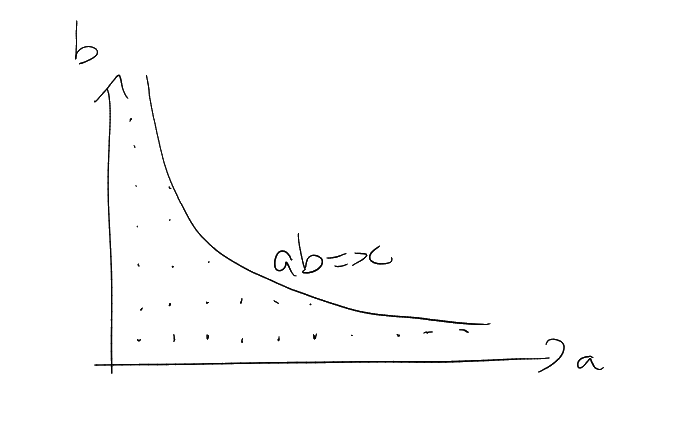
Problem: How many lattice points (a,b)∈ℕ2 satisfy ab≤x?

PIC

Note that this number is ∑⁡n≤xτ(n)=∑ab≤x1.

Dirichlet proved that for x≥2,

∑n≤xτ(n)=x log ⁡x+(2γ−1)x+O(x1∕2)

where γ is Euler’s constant.

We will see a proof of this shortly.

Conjecture: Can have O𝜀(x14+𝜀). Current best exponent is 0.314.

First, we prove a lemma:

Lemma (Dirichlet hyperbola method). Assuming that:

  • f,g:ℕ→ℂ

  • x≥y≥1

Then
∑n≤x(f∗g)(n)=∑d≤yf(d)∑m≤xdg(m)+∑m≤xyg(m)∑y<d≤xmf(d).

Proof. ∑⁡n≤x(f∗g)(n)=∑dm≤xf(d)g(m). Split this sum into parts with d≤y and d>y to get the conclusion. □

Theorem 1.5 (Dirichlet’s divisor problem). For x≥2,

∑n≤xτ(n)=x log ⁡x+(2γ−1)x+O(x1∕2)

where γ is Euler’s constant.

Proof. We use the Dirichlet hyperbola method, with y=x12. Note that τ=1∗1. Then,

∑n≤xτ(n)=∑d≤x12∑m≤xd1+∑m≤x12∑x12<d≤xm1=∑x≤x12(xd+O(1))+∑m≤x12(xm−x12+O(1))=x∑d≤x121d+x∑m≤x121m−∑m≤x12x12+O(x12)

Recall from Lecture 2 that

∑d≤y1d= log ⁡y+γ+O(1y).

Taking y=x12, the previous expression becomes

2×(12log⁡x+γ+O(1x12))−x+O(x12)=xlog⁡x+(2γ−1)x+O(x12).□